
If you are new to fiber optics, the number of connection methods can be overwhelming. You have fusion splicing, mechanical splicing, and a growing list of “no-tool” options. Two terms that often cause confusion are the Fiber Fast Connector and the Mechanical Splice.
At first glance, they look similar. Both are small, both are used in the field, and both avoid the high cost of a fusion splicer. But are they the same? Absolutely not. Using the wrong one can mean the difference between a stable network and a service call tomorrow. In fact, confusing these two devices is one of the most common mistakes made by new fiber technicians.
Let’s break down the confusion, starting with the basics.
Table of contents
- What Is a Mechanical Splice?
- What Is a Fiber Fast Connector (Fiber Quick Connect)?
- The Key Differences
- When Should You Choose Each?
- Common Mistakes to Avoid
What Is a Mechanical Splice?

First, we need a clear definition. What is a mechanical splice? It is a permanent (but removable) joining device for two bare optical fibers. Unlike fusion splicing, which melts glass together, a mechanical splice simply holds the two fibers in precise alignment using physical force.
Inside a mechanical splice, the two prepared fiber ends are aligned precisely using a V-groove or similar mechanism and then held together with a refractive index matching gel. This gel serves two purposes: it reduces back reflection (return loss) and prevents air gaps that would cause signal loss. The splice is held closed by a latch or a crimp mechanism, which applies constant pressure to keep the fibers touching.
Think of it as a “butt connector” for fiber. It takes two separate cables and permanently joins them end-to-end. It does not have a connector body (like an SC or LC plug); it is strictly a splicing device. You would typically find mechanical splices installed inside a splice closure, an enclosure box, or a wall-mounted termination panel where two cables need to be extended.
What Is a Fiber Fast Connector (Fiber Quick Connect)?
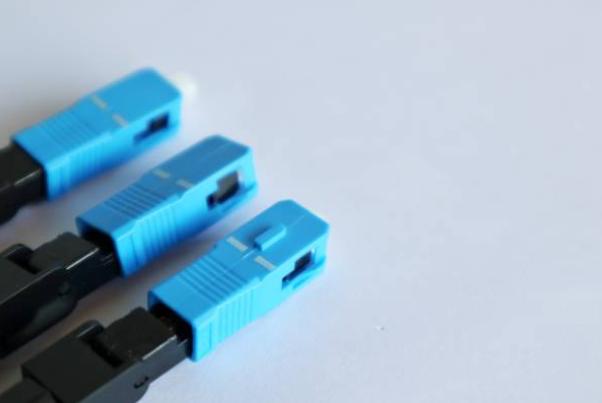
Now, let’s look at the alternative. A fiber fast connector (often called a fiber quick connect) is a pre-polished connector (usually SC or LC style) designed to terminate a single fiber cable onto a connector body. It eliminates the need for epoxy, polishing film, or curing ovens, making it ideal for rapid field installations.
Unlike a mechanical splice, a fast connector does not join two cables together. Instead, it turns a raw fiber cable into a “plug.” You insert the prepared fiber into the back of the connector until it clicks or locks, and an internal mechanical clamping mechanism holds the fiber against a pre-polished ceramic ferrule. The ferrule is the round tip that physically inserts into an adapter or port.
Most fiber fast connectors come with a built-in shutter or dust cap to protect the ferrule before use. They are commonly used by Fiber-to-the-Home (FTTH) technicians who need to install a wall outlet or connect directly to an optical network terminal (ONT) without waiting for glue to dry.
The Core Relationship
Before we dive into differences, let’s state the relationship clearly:
A field-installable connector (fiber fast connector) is a mechanical splice that has been integrated with a pre-polished ferrule and connector housing to turn a bare fiber into a plug.
In other words: a fast connector incorporates the functionality of a mechanical splice internally. This is why they look similar, use similar tools, and are so easily confused. But their purpose is completely different.

The Key Differences
So, why can’t you swap one for the other? Here are the two true intrinsic differences — everything else is a consequence of these.
-
Number of Fibers They Handle (Joiner vs Terminator)
Mechanical Splice: Has two openings. It joins two bare fiber ends together. Fiber A goes in one side; Fiber B goes in the other. Result: one longer continuous fiber.
Field-Installable Connector (Fiber Fast Connector): Has one opening. It terminates a single bare fiber end into a plug. Fiber goes in the back; a pre-polished ferrule comes out the front. Result: a connector ready to plug into a port.
Why this matters in practice (the “Pigtail” Rule): If you have a fiber cable in the wall and need to connect it to a device, you have two paths:
Use a fast connector directly (terminate the raw fiber).
Use a mechanical splice + a pigtail (join the raw fiber to a factory-made connector cable).
Both achieve the same goal, but the choice depends on whether you prioritize speed (fast connector) or long-term reliability (splice + pigtail). This is not a separate difference — it is simply an application of the joiner-vs-terminator distinction.
-
Presence of a Ferrule (What Plugs Into the Port)
Mechanical Splice: No ferrule. It has no protruding tip. You cannot plug it into an adapter, switch, or ONT. It lives inside splice trays and enclosures.
Field-Installable Connector (Fiber Fast Connector): Has a ceramic or metal ferrule. This ferrule is the round tip that physically inserts into a port. The ferrule is pre-polished at the factory, which is why you don’t need to polish it in the field.
-
Insertion Loss and Return Loss
Mechanical Splice: Average loss ~0.1 to 0.3 dB. Because the fibers are simply butted together with index matching gel, there is very little glass-to-air interface, which keeps the signal strong. Return loss (reflections) is generally good, typically around -40 to -50 dB.
Fiber Fast Connector: Average loss ~0.3 to 0.5 dB (though premium versions can be lower). The higher loss is due to the fact that the field-installed fiber must align perfectly with the pre-polished ferrule inside the connector—any microscopic gap or misalignment creates loss. Return loss can also be worse if the cleaved fiber end is not perfectly smooth or if dust gets trapped inside.
In practical terms, a 0.2 dB difference might not sound like much, but over multiple connections (say, 10 splices and 10 connectors), those losses add up quickly and can push a link over its optical budget.
When Should You Choose Each?
Use a Mechanical Splice when: You are repairing a broken cable, creating a permanent splice in an enclosure, or attaching a factory-made pigtail to a long run of cable. Also use it when you have limited space inside a splice tray, as mechanical splices are compact and designed for dense installations.
Use a Fiber Fast Connector when: You need a temporary test point, you are in an emergency restoration where speed is everything, or you have a very short run where 0.5 dB of loss is acceptable. They are also excellent for low-budget educational labs where buying a fusion splicer is not feasible.
Common Mistakes to Avoid
- Using a Mechanical Splice Where a Connector Is Required
This mistake often leads to installation issues, as network equipment typically requires standard connector interfaces. Without a connector, additional adaptation becomes necessary, increasing complexity and potential loss.
- Assuming Fiber Quick Connect Is Just a Splice
While it uses mechanical splice technology internally, a fiber fast connector is a complete termination solution. Treating it as just a splice underestimates its role in structured cabling systems.
- Ignoring Fiber Preparation Quality
Both solutions rely heavily on proper fiber stripping, cleaning, and cleaving. Even the best connector or splice will perform poorly if the fiber end-face is not prepared correctly.
Conclusion
So, are they the same?
No—but they are closely related and often used together in fiber networks.
A mechanical splice is used to join two fibers directly, mainly for repair or temporary connections
A fiber fast connector (fiber quick connect) is used to terminate a fiber into a connector, enabling easy connection to devices
Understanding their differences allows you to:
Choose the right solution for each scenario
Reduce installation errors
Improve overall network performance and reliability


