
In the rapidly evolving world of telecommunications, the demand for high-speed internet and reliable network infrastructure has never been greater. Fiber optic technology stands at the heart of this digital revolution, enabling lightning-fast data transmission that powers everything from streaming services to cloud computing. However, one of the most persistent challenges in fiber deployment has been the termination process—connecting individual fibers to equipment quickly, reliably, and cost-effectively.
Enter the fiber fast connector, a game-changing innovation that has transformed how network technicians handle fiber terminations in the field. These compact devices have become indispensable tools in modern fiber deployments, particularly in Fiber-to-the-Home (FTTH) rollouts, data center expansions, and emergency network repairs. By eliminating the need for expensive fusion splicers, messy epoxy compounds, and time-consuming polishing procedures, fiber fast connectors have dramatically reduced installation times and lowered the barrier to entry for fiber optic network construction.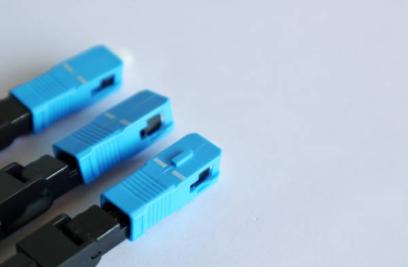
This comprehensive guide explores everything you need to know about optical fast connector—from their internal construction and various types to installation best practices and real-world applications.
- What Is a Fiber Fast Connector?
- Types of Fiber Fast Connectors
- Optical Fast Connector Installation Guide
- Applications of Fiber Fast Connectors
- Conclusion
What Is a Fiber Fast Connector?
A fiber fast connector—also referred to as a field-installable connector, mechanical splice connector, or pre-polished connector—is a mechanical device that allows a single optical fiber to be terminated in the field without requiring fusion splicing or factory-style polishing. These connectors are designed for rapid on-site installation, typically taking less than three minutes to complete from start to finish.
Unlike traditional termination methods that demand trained technicians, specialized equipment, and controlled environments, fiber fast connectors empower installers with a simple, repeatable process that consistently delivers reliable optical performance.
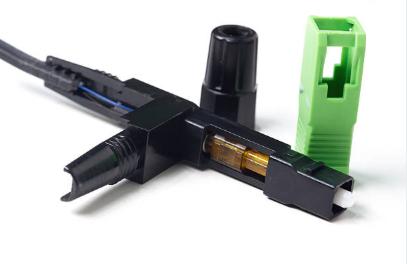
Internal Construction and Working Principle
| Component | Function |
| Ferrule | A precision ceramic cylinder (typically 1.25mm for LC or 2.5mm for SC) that holds and aligns the fiber. Factory-polished to an exacting standard. |
| Pre-polished Fiber Stub | A short length of fiber already installed and polished within the ferrule. The field fiber will splice mechanically to this internal stub. |
| V-Groove Alignment Mechanism | A precision-etched channel that guides the field fiber into perfect alignment with the internal stub, typically with micron-level accuracy. |
| Index-Matching Gel | A specialized fluid that fills the microscopic gap between the field fiber and internal stub, reducing Fresnel reflections and minimizing insertion loss. |
| Mechanical Clamping System | A cam, wedge, or sliding housing that, when actuated, permanently secures the fiber and maintains optical contact. |
| Strain Relief Boot | A flexible protective covering that prevents bending stress from transferring to the fiber termination point. |
Types of Fiber Fast Connectors
Selecting the right optical fast connector type is crucial for ensuring compatibility with existing network equipment and achieving optimal performance. Fiber fast connectors are available in several form factors and polish types, each suited to specific applications.
SC Fiber Fast Connectors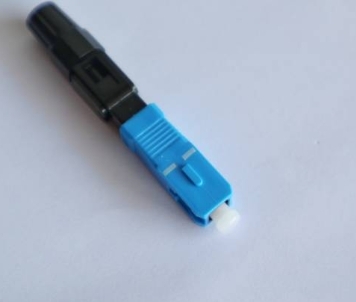
The SC (Standard Connector or Subscriber Connector) is one of the most widely used fiber connector types in telecommunications. It features a 2.5mm ferrule and a push-pull latching mechanism that provides secure, positive engagement.
Key Characteristics:
- Ferrule diameter: 2.5mm
- Latching: Push-pull
- Durability: Excellent; withstands 500+ mating cycles
Advantage:
This is the workhorse you want when you’re out in the field, wearing gloves, working on a ladder, or dealing with messy outdoor conditions. The push-pull design is brutally simple—you just push it in until it clicks, and pull it out when you need to. No fumbling with tiny latches or screws. It’s big enough that you can see what you’re doing, and it stays put once it’s locked. For FTTH installations where you’re connecting hundreds of homes, this saves you from hand cramps and frustration.
Drawback:
It’s chunky. If you’re working in a cramped telecom cabinet or a densely packed data center, that 2.5mm ferrule eats up space fast. You’ll fit maybe 24 of these on a 1U panel, which means you’ll run out of real estate long before you run out of fibers to connect. For high-density environments, you’ll feel the space squeeze every single time you reach for another port.
Best For: Telecom networks, residential FTTH installations, and applications where space constraints are not critical.
LC Fiber Fast Connectors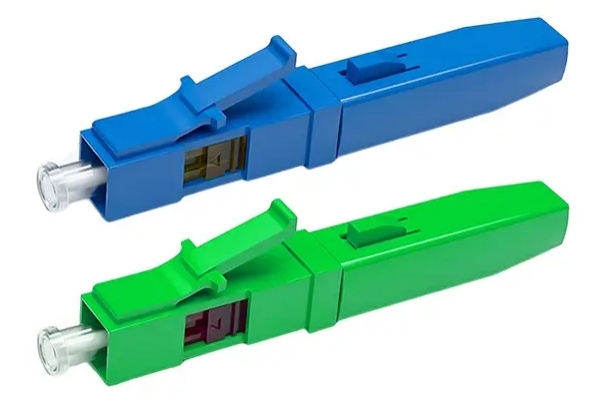
The LC (Lucent Connector) was developed to meet the growing demand for higher-density fiber connections. With a ferrule half the size of the SC (1.25mm), the LC connector enables significantly more ports in the same physical space.
Key Characteristics:
- Ferrule diameter: 1.25mm
- Latching: RJ-45 style latch (click mechanism)
- Port density: 48 ports per 1U rack (versus 24 for SC)
Advantage:
This is your best friend in tight spaces. At half the size of an SC, the LC lets you pack twice as many connections in the same rack space—48 ports per 1U versus 24. For data center techs, that’s a game-changer. The little latch clicks in like an RJ-45 Ethernet plug, so you get that satisfying audible snap that tells you it’s properly seated without having to second-guess yourself. It’s also the standard for modern SFP transceivers, so you’re not fighting with adapters or compatibility headaches.
Drawback:
Everything is tiny and fiddly. Those 1.25mm ferrules are delicate, and if you’ve got big hands or work in poor lighting, you’ll find yourself squinting and cursing more often than you’d like. The latch mechanism, while secure, can be awkward to release in dense panels—you’ll frequently need one hand to push the release while the other pulls the connector, and if the panel is crowded, your fingers don’t fit. It’s not a connector for sloppy work or rushed installations.
Best For: Data centers, enterprise LANs, and any environment where space efficiency is paramount.
FC Fiber Fast Connectors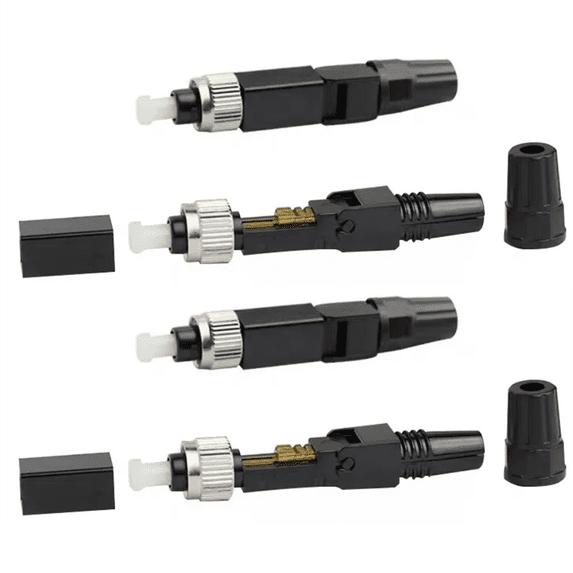
The FC (Ferrule Connector) is a legacy connector type that remains prevalent in certain industrial and telecom applications, particularly where vibration and mechanical stability are critical concerns. While its popularity has declined with the rise of SC and LC connectors, the FC’s unique characteristics make it irreplaceable in specific niche applications.
Key Characteristics:
- Ferrule diameter: 2.5mm
- Latching: Threaded screw-on coupling that physically locks the connector in place
- Orientation: Keyed alignment that ensures the fiber is inserted in the correct rotational orientation
Advantage:
If your equipment shakes, vibrates, or gets bumped around—think industrial factories, cell towers, or outdoor cabinets near heavy machinery—this is the connector that will not come loose. The threaded screw-on ring means it’s locked down tight until you physically unscrew it. You also get the keyed alignment, which is critical if you’re using APC polish because it ensures you never plug it in rotated wrong. For legacy telecom techs who grew up on FC connectors, it’s familiar and trustworthy.
Drawback:
It’s slow and annoying to install and remove. Every single connection requires twisting that metal ring on and off, which adds up to a lot of wrist action over a day’s work. You absolutely cannot do it one-handed—you need to hold the connector body while spinning the coupling nut, which is a pain when you’re reaching into a crowded panel. And honestly? It’s old tech. Most modern networks have moved on to SC or LC, so you’re often dealing with compatibility issues and hunting for hybrid cables.
Best For: Industrial environments, vibration-prone installations, and networks requiring retroactive compatibility with older equipment. The FC connector’s robust mechanical design ensures reliable performance where other connectors might fail.
UPC vs. APC Fiber Fast Connectors
Beyond the physical form factor (SC, LC, FC), optical fast connector are also classified by their polish type, which refers to the shape of the ferrule’s end-face where the light exits and enters the fiber. The choice between UPC (Ultra Physical Contact) and APC (Angled Physical Contact) significantly impacts optical performance, particularly return loss—the amount of light that reflects back toward the source, which can interfere with signal quality in sensitive applications.
UPC Connectors are the standard choice for most telecommunications and data networking applications. The slightly curved end-face ensures that the fiber cores make physical contact when mated, minimizing air gaps and reducing back reflections. They offer excellent performance at a reasonable cost and are compatible with the vast majority of network equipment, making them the default choice for most installations. You won’t notice any performance difference unless you’re running sensitive lab tests. It’s the “just works” option.
APC Connectors, with their 8-degree angled end-face, dramatically reduce back reflections (return loss) by ensuring that any reflected light is directed off-angle into the cladding where it is absorbed rather than traveling back along the fiber core toward the transmitter. If you’re working on cable TV (CATV), RF video, or any analog transmission, APC is your savior. It gives you that extra margin of safety against signal degradation.

Critical Warning: Never mate an APC connector with a UPC connector! The angled ferrule will permanently gouge and damage the flat-polished end-face of a UPC connector, requiring immediate replacement of both connectors and potentially causing signal loss or equipment damage that disrupts network service.
Optical Fast Connector Installation Guide
Proper installation is the cornerstone of reliable fiber fast connector performance. While these connectors are designed for ease of use, attention to detail during preparation and installation directly impacts insertion loss, return loss, and long-term durability. Even the best connector will fail if the fiber is not prepared correctly, as the precision alignment mechanisms cannot compensate for poor cleave quality or surface contamination.
The general installation process includes fiber stripping, cleaning, cleaving, connector assembly, and testing.
For a detailed installation demonstration, please refer to our related fiber fast connector installation video and step-by-step installation guide.
Recommended Video Resources:
Broken Fiber?A Fast Connector Can Fix It
Suggested Articles:
Fiber Optic Connector Installation: A Guide to Fast Connectors
Applications of Fiber Fast Connectors
The versatility and ease of use of fiber fast connectors have made them the preferred choice across a wide spectrum of fiber optic applications.
FTTH (Fiber-to-the-Home) Networks
FTTH deployments represent the largest and most visible application of fiber fast connectors. Network operators building out residential fiber networks face immense pressure to connect thousands of homes quickly and cost-effectively.
Data Center Cabling
Modern data centers are the backbone of cloud computing, streaming services, and enterprise IT. The relentless drive for higher bandwidth and lower latency has pushed data center operators to seek termination solutions that can keep pace with ever-increasing port counts and density requirements.
FTTx Deployments (FTTB, FTTC, FTTD)
Beyond FTTH, fiber fast connectors play a vital role in the broader FTTx ecosystem, including:
- FTTB (Fiber-to-the-Building): Connecting fiber to multi-tenant buildings where distribution is handled via copper or wireless internally
- FTTC (Fiber-to-the-Curb): Deploying fiber to street-level cabinets serving multiple subscribers
- FTTdp (Fiber-to-the-Distribution Point): Connecting fiber to small distribution points serving 8-16 subscribers
Conclusion
A fiber fast connector provides a fast, practical, and flexible solution for fiber optic termination. By using mechanical alignment technology instead of fusion splicing, it significantly reduces installation time and lowers the equipment requirements for field technicians.
With advantages such as quick deployment, easy operation, and strong flexibility, optical fast connectors have become an important choice for FTTH, FTTx, fiber repair, and access network applications.
However, achieving reliable performance still depends on correct installation practices. Proper fiber preparation, careful cleaning, accurate cleaving, and post-installation testing are essential to ensure low optical loss and long-term network stability.
As fiber networks continue to expand, fiber fast connectors will remain a valuable technology for accelerating fiber deployment and simplifying network maintenance.


