
Fiber optic networks rely on countless connection points where cables are spliced, branched, or repaired. These exposed splices must withstand moisture, dust, mechanical stress, and temperature fluctuations—and that is precisely the role of a fiber optic closure. Whether you are deploying FTTH, expanding a metropolitan backbone, or repairing damaged cables, proper fiber optic closure installation directly determines long-term network reliability and future maintenance costs.
- What Is a Fiber Closure?
- Step-by-Step Fiber Optic Closure Installation
- Common Mistakes to Avoid
- How to Maintain a Fiber Closure

What is a fiber closure? It is a protective enclosure that houses fiber splices and cable joints. Its core functions include waterproofing and dustproofing, organizing fiber slack, providing mechanical strain relief, and enabling future expansion or re-entry. Without a properly installed closure, fiber connections become vulnerable to water ingress, cable tension, and physical damage.
Why does installation quality matter? A poorly installed closure rarely fails immediately. Problems typically surface months or years later—as increased insertion loss, fiber breakage, water penetration, intermittent outages, higher operational costs, and shortened network lifespan. A single properly installed closure can protect your network for over a decade. The cost of locating and repairing a failed closure—whether buried underground or suspended on a pole—far outweighs the upfront investment in a quality closure and disciplined installation practices.

Step-by-Step Fiber Optic Closure Installation
A successful fiber optic closure installation is a systematic process. It begins with planning and ends with thorough testing. Choosing the right closure for the job is the first critical step, considering factors like application (aerial, buried, or underground), cable type, and the number of fibers to splice.
1. Preparation is Key
Before you even open the closure kit, the work begins.
Site Selection: The mounting location must be chosen with care. For aerial installations, a minimum height (e.g., 5 meters above ground) is often specified to ensure safety. Underground closures must be placed below the frost line to prevent damage from shifting soil.

Gathering the Right Tools: An installation requires a specialized toolkit, including a fusion splicer, an OTDR (Optical Time-Domain Reflectometer) for testing, fiber cleavers, and various sealing materials.

Inspect the Fiber Closure Before Installation: Never assume the closure is ready to use out of the box. Perform a thorough pre-installation inspection:
- Check for physical damage.
- Verify all sealing components are included.
- Inspect rubber gaskets and cable seals.
- Confirm cable port sizes match the incoming cable diameter.
2. The Art of Fiber Cable Preparation
This is the most delicate and crucial phase. Careful cable preparation is non-negotiable.
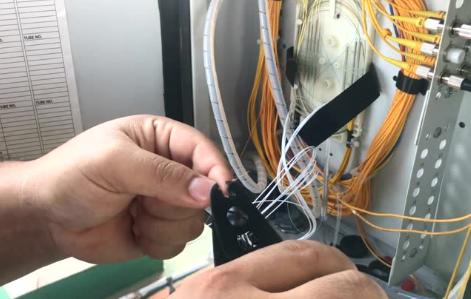
Stripping the Cable: The outer jacket must be removed without nicking or damaging the delicate buffer tubes and fibers inside. If the cable is gel-filled, the filling compound must be thoroughly cleaned away to prevent it from contaminating the closure and interfering with future work.
Securing the Cable: The cable’s strength members (aramid yarn or steel wire) are clamped to the closure’s frame. This ensures that any strain on the cable is transferred to the closure’s structure, not to the spliced fibers inside. This step is vital for the mechanical integrity of the installation.
Bonding and Grounding: For cables with metallic components, proper bonding and grounding are essential to prevent electrical hazards and ensure the safety of the network and its technicians.
3. Fiber Splicing and Management
Once the cable is prepped, the fibers are ready to be joined. This is where the fiber closure truly proves its value.
Splicing: The preferred method is fusion splicing, which uses an electric arc to melt and fuse the fiber ends together. A high-quality fusion splice has an extremely low loss, typically ≤0.05dB.
Managing in the Trays: The spliced fibers are not just left loose. They are carefully arranged in splice trays, a key component of the closure. The fibers are coiled and secured within these trays to protect them from stress and maintain a safe bend radius. For ribbon fiber, careful planning is needed as they only bend in one direction. This fiber management is critical for the long-term health of the network.

4. Sealing and Final Closure
After all splices are complete and secured, the closure is sealed to make it impervious to the environment.
Applying the Seal: Depending on the closure type, this might involve a mechanical rubber gasket system that allows for easy re-entry, or a heat-shrink seal that provides a more permanent, airtight bond. Fiber closure designs like dome closures are popular for their ease of handling and reliable single-end sealing.
Testing: Before the job is considered done, the network must be tested. An OTDR is used to verify that all splices have low loss and the entire link is performing as expected. A visual fault locator can also help spot any breaks.
Common Mistakes to Avoid through Fiber Optic Closure Installation
Even experienced technicians can fall into bad habits. Here are the most frequent errors to watch for during fiber optic closure installation:
Skipping the pre-installation inspection: A damaged seal or missing component can doom the closure before you begin.
Improper cable stripping: Nicks or scratches on the fibers create stress points that lead to breakage over time.
Inadequate cleaning: Gel residue or dust contaminates splice trays and can cause signal degradation.
Poor fiber management: Cramming fibers into trays without maintaining bend radius leads to microbending losses.
Over-tightening seals: This can deform gaskets and actually reduce their waterproofing effectiveness.
Neglecting documentation: Failing to record splice locations and fiber mapping makes future maintenance extremely difficult.
How to Maintain a Fiber Closure
Although fiber optic closures are designed for long service life, periodic inspection is recommended.
Maintenance should include:
- Checking external housing for cracks
- Inspecting mounting brackets
- Verifying waterproof seals
- Cleaning external surfaces
- Confirming cable strain relief
- Testing optical performance when necessary
Preventive maintenance helps identify potential issues before they cause service interruptions.
Conclusion
The choice and installation of a fiber optic closure is an investment in the future. Cutting corners on a cheap closure or rushing through the installation process is a false economy. The cost of finding and repairing a failed closure buried underground or strung high on a pole far outweighs the initial savings. A high-quality closure, installed with precision, will protect the fiber network for a decade or more, ensuring the uninterrupted flow of data that our world depends on.
Ready to Secure Your Network with High-Quality Closures?
Don’t leave your fiber infrastructure to chance. Explore our full range of IP68-rated dome and in-line fiber optic closures, designed for aerial, underground, and buried applications.


