
For years, Power over Ethernet (PoE) has been one of the most practical solutions for powering IP cameras, wireless access points, VoIP phones, and other network devices through a single Ethernet cable.
However, as networks move toward higher bandwidth, longer transmission distances, greater electromagnetic interference immunity, and improved electrical safety, Power over Fiber (PoF) is attracting growing attention. In particular, power over fiber PoF technology provides a fundamentally different approach: instead of sending electrical current through copper conductors, it transmits energy as light through optical fiber and converts it back into electrical power at the remote end.
So, when comparing PoE vs PoF, which technology is better? The answer depends on the application. PoE remains highly practical for conventional Ethernet deployments, while PoF offers significant advantages in environments where long-distance transmission, electrical isolation, and EMI immunity are critical.
This article explains how PoE and PoF work, compares their key differences, examines their applications, and looks at why Power over Fiber may become increasingly important in future network architectures.
- What Is PoE?
- What Is Power over Fiber (PoF)?
- PoE vs PoF: Head-to-Head Comparison
- Application Scenarios: Where Each Technology Wins
- Future Outlook
- Conclusion
1. What Is PoE?
Definition and History
Power over Ethernet (PoE) is a standardized technology that delivers electrical power alongside data over standard Ethernet copper cabling. The journey began with the IEEE 802.3af standard in 2003, which provided up to 15.4 watts of power per port. This was sufficient for basic IP cameras and VoIP phones.
As device power requirements grew, the IEEE 802.3at standard (PoE+) increased capacity to 30 watts, enabling pan-tilt-zoom cameras and high-performance access points. Today, IEEE 802.3bt (PoE++) delivers up to 90 watts per port through all four twisted pairs in a Cat6 cable, making it possible to power LED lighting systems, digital signage, and even some laptops.
How PoE Works
PoE operates on a simple principle. Power Sourcing Equipment (PSE)—typically a PoE switch or midspan injector—sends direct current (DC) over the same copper wires used for data transmission. The powered device (PD) at the far end, such as a camera or access point, receives both signals and separates them internally.
A discovery process ensures safety: the PSE sends a small voltage to check if a compatible device is connected before delivering full power. This prevents damage to non-PoE equipment.
Key Specifications
- Power Output: Up to 90W (PoE++, IEEE 802.3bt)
- Maximum Distance: 100 meters (328 feet) without a repeater or extender
- Cabling: Cat5e, Cat6, or higher grade twisted-pair copper
- Voltage Range: 44–57V DC
- Primary Applications: IP security cameras, wireless access points, VoIP phones, LED lighting, digital signage
2. What Is Power over Fiber (PoF)?
Definition
Power over Fiber encompasses two distinct approaches to delivering energy via fiber optic infrastructure. Unlike PoE, which uses copper conductors, PoF leverages the advantages of optical transmission—either entirely through light or through hybrid cabling.
A. Pure Optical PoF
In this approach, a high-power laser or VCSEL (Vertical-Cavity Surface-Emitting Laser) transmits optical energy through standard fiber optic cables. At the receiving end, a specialized Photovoltaic Power Converter (PPC) converts that light back into usable electrical power. This method achieves complete electrical isolation since the fiber contains no conductive material.
Power over fiber PoF in its pure optical form is still evolving, with current systems delivering anywhere from 1W to 10W over distances exceeding 1 kilometer. Research continues to push these limits, aiming for higher wattage and greater efficiency.
B. Hybrid PoF
Hybrid PoF takes a more practical approach by combining optical fibers and copper conductors within a single ruggedized cable jacket. The optical fibers handle ultra-high-speed data transmission, while the copper wires deliver power separately. This design offers the “best of both worlds”: massive data bandwidth with reliable DC power delivery.
Hybrid cables typically extend from 300 meters up to 2 kilometers, depending on the copper gauge and voltage applied. This makes them ideal for industrial applications where running separate power and data cables would be prohibitively expensive.
The Physics Behind PoF
The fundamental advantage of power over fiber lies in the properties of glass. Copper cables suffer from DC resistance, causing voltage drop over distance. Fiber optics, however, transmit light with minimal attenuation. Data signals can travel tens of kilometers without regeneration. Power transmission through light, while less efficient than copper over short distances, becomes increasingly viable as distance grows and electrical losses in copper become prohibitive.
Key Specifications (Pure Optical PoF)
- Power Output: Typically 1–10W (current generation)
- Maximum Distance: 1 km to 10+ km (depending on laser power and fiber quality)
- Cabling: Standard single-mode or multimode fiber; specialty fibers for higher power
- Safety: Total galvanic isolation, intrinsically safe for explosive environments
- Data Bandwidth: Essentially unlimited—multi-gigabit to terabit scale
Key Specifications (Hybrid PoF)
- Power Output: Up to 50W+ (via copper conductors)
- Maximum Distance: 300m to 2 km (limited by copper voltage drop)
- Cabling: Composite cable with fiber and copper conductors
- Data Bandwidth: Multi-gigabit over fiber
- Primary Applications: Remote sensors, 5G small cells, oil and gas, transportation
3. PoE vs PoF: Head-to-Head Comparison
Transmission Distance
This is the most critical differentiator in the PoE vs PoF debate.
PoE: The 100-meter rule is non-negotiable. Beyond this distance, DC resistance causes significant voltage drop, and signal attenuation degrades data integrity. Extenders and repeaters can bridge gaps, but each active component introduces cost and failure points.

PoF: For data transmission, fiber distances are measured in kilometers—virtually unlimited for practical network purposes. For power transmission, pure optical PoF can easily exceed 1 kilometer, with research demonstrating successful delivery beyond 10 kilometers. Hybrid systems typically reach 300–2,000 meters, still far surpassing standard PoE.
Key Insight: If your deployment exceeds 100 meters, PoF is the only viable option for combined power and data delivery.
Safety and Environment (Galvanic Isolation)
PoE: Copper is conductive. This introduces several risks. Lightning strikes can induce surges that travel along cables, damaging equipment and creating fire hazards. Ground loops—caused by different ground potentials at each end—can cause equipment malfunction or failure. Additionally, copper cables are susceptible to Electromagnetic Interference (EMI) from heavy machinery, motors, and high-voltage lines.
PoF: Fiber is a dielectric material—it does not conduct electricity. This provides total galvanic isolation between the power source and the powered device. There is no path for lightning surges, no risk of ground loops, and complete immunity to EMI. In explosive atmospheres such as chemical plants, oil refineries, and mining operations, power over fiber is classified as intrinsically safe, eliminating the risk of sparks.
Key Insight: For harsh, outdoor, or industrial environments, PoF offers safety advantages that PoE cannot match.
Infrastructure Costs
PoE: Deployment costs are low. Cat5e and Cat6 copper cabling is inexpensive and widely available. Standard PoE switches integrate seamlessly into existing network infrastructure. Termination requires no specialized training beyond basic network certification.
PoF: The upfront investment is higher. Lasers and Photovoltaic Power Converters are more expensive than standard PoE injectors. Fiber optic termination requires specialized skills, tools, and testing equipment. However, for long-distance deployments, the cost of PoF may actually be lower than the combined expense of multiple PoE switches, repeaters, and AC power installations along the cable path.
Key Insight: PoE wins on short-run cost; PoF wins when distance and infrastructure complexity are factored in.
Data Bandwidth
PoE: Copper bandwidth is improving but remains limited. Cat6a can support 10 Gbps over short distances (up to 55 meters), but beyond that, performance degrades rapidly. For enterprise networks, this limitation is acceptable today but may become a bottleneck as 10G and 25G become standard.
PoF: Fiber is inherently future-proof. Today’s networks already deploy 100 Gbps and 400 Gbps over fiber, with terabit speeds on the horizon. This bandwidth is distance-independent—a 10 km fiber link can carry the same speed as a 1-meter link.
Key Insight: If your network demands multi-gigabit speeds over long distances, PoF is the clear winner.
4. Application Scenarios: Where Each Technology Wins
Where PoE Still Dominates
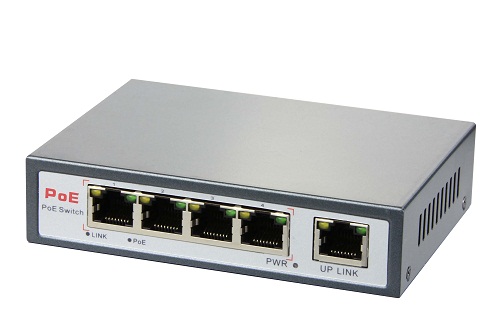
PoE remains the go-to solution for conventional indoor networking environments where distances are short, and power requirements are moderate.
Typical PoE Switch Deployments:
- Office Buildings: Powering Wi-Fi access points, VoIP desk phones, and conference room displays. Cable runs rarely exceed 50 meters.
- Retail Environments: Connecting security cameras, digital signage, and inventory tracking systems.
- Hotel and Hospitality: Powering in-room communication devices, hallway cameras, and lobby displays.
- Education: Classroom access points and interactive whiteboards.
In these scenarios, PoE switches provide cost-effective, plug-and-play power delivery without the complexity of fiber termination.
Where PoF Is Becoming Essential
As networks push into demanding environments, power over fiber PoF is transitioning from a niche technology to a mandatory solution.
Typical PoF ONT Deployments:
- Smart Transportation: Monitoring railway tracks, highway traffic cameras, and tunnel safety systems. Power outlets are often miles apart, making PoF the only practical option.
- Renewable Energy: Wind turbine farms and solar installations require EMI-resistant cabling that can withstand lightning strikes. PoF provides both.
- Oil, Gas, and Mining: Explosive atmospheres demand intrinsically safe equipment. Pure optical PoF eliminates spark risk entirely.
- 5G/6G Infrastructure: Small cells and remote antenna units must be placed precisely for optimal coverage, often on poles or rooftops where AC power is unavailable.
- Military and Secure Networks: Fiber does not emit stray electromagnetic signals, making it extremely difficult to tap without detection. This makes PoF ideal for classified installations.
In these scenarios, PoF optical network terminals (ONTs) provide reliable power and data where traditional copper solutions simply cannot reach.

5. Future Outlook
The PoE vs PoF landscape is evolving rapidly, and the future points toward coexistence rather than outright replacement.
Standardization: While PoE is heavily standardized under IEEE, PoF remains largely proprietary today. However, this is changing. The IEEE 802.3cz standard for automotive and industrial PoF is under development, promising to bring interoperability and cost reduction to the market.
Power Efficiency: Photovoltaic Power Converter efficiency continues to improve. Researchers are achieving conversion rates above 50%, closing the gap with copper-based transmission. Higher-power lasers capable of delivering 50W or more over pure optical fiber are in development.
Cost Reduction: As laser and PPC manufacturing scales, component costs will decline. Termination tools and training will become more accessible, reducing the skill barrier for network installers.
Hybrid as the Bridge: Hybrid PoF solutions will likely see the fastest adoption, offering a gradual migration path. Enterprises can deploy hybrid cable today, leveraging fiber for data and copper for power, with the option to transition to pure optical as the technology matures.
Long-Term Prediction: Over the next decade, Power over Fiber will expand from industrial and carrier applications into enterprise environments—particularly for campus networks with long outdoor runs, where lightning protection and distance have always been challenges.
6. Conclusion
The choice between PoE and PoF is not about which technology is “better” in absolute terms. It is about selecting the right tool for the right job.
PoE remains the undisputed champion of indoor, short-distance networking. It is simple, affordable, and ubiquitous. For most offices, schools, and retail spaces, PoE switches will continue to provide reliable power and data for years to come.
Power over Fiber, however, represents the future of long-distance and harsh-environment networking. Whether through pure optical delivery or hybrid cable designs, power over fiber PoF solves the distance, safety, and interference problems that have always constrained copper. As standards emerge and costs decline, PoF will become increasingly accessible to mainstream deployments.
Audit your current network infrastructure. Are you struggling with 100-meter distance limits? Are you replacing equipment damaged by lightning or EMI? If so, it may be time to explore Power over Fiber for your next deployment. The future of networking is longer, safer, and faster—and fiber is leading the way.


