
In today’s world of high-speed internet, cloud computing, and advanced telecommunications, fiber optic cables play a critical role in ensuring fast, reliable, and efficient data transmission. One essential component that makes this possible is the fiber patch cord. But what exactly is a fiber patch cord, and what is the use of patch cord? Let’s dive into this often-overlooked piece of technology to understand its importance.
What is a Fiber Patch Cord?
A fiber patch cord is a short optical fiber cable with connectors on both ends. It is used to connect different devices within a fiber optic network, providing a pathway for data signals to travel. These cords are designed to be flexible and durable, allowing for easy installation and maintenance. Whether you’re building a network from scratch, troubleshooting, or upgrading your infrastructure, a fiber patch cord is likely to be part of the setup.

How Does It Work?
At its core, a fiber patch cord contains one or more incredibly thin strands of glass or plastic fiber, each about the diameter of a human hair. These strands are the “optical fibers.” Data is transmitted as pulses of light generated by a laser or LED, which travel down the fiber by bouncing off its mirrored inner walls—a principle called total internal reflection.
The cord is sheathed in protective material, and its ends are terminated with precise connectors (common types include LC, SC, ST, and MTP/MPO) that align the microscopic fiber core perfectly with the equipment port, ensuring minimal signal loss.
What is a Patch Cord Used for?
Connecting Fiber Optic Devices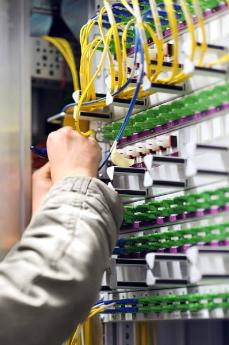
One of the primary uses of fiber patch cords is to connect different pieces of equipment in a fiber optic network. This includes devices like:
Optical Transceivers: These are used to convert electrical signals into optical signals (and vice versa). A fiber patch cord connects the transceiver to the fiber optic network.
Switches, Routers, and Servers: These network devices are often connected using fiber patch cords to ensure that data is transmitted efficiently over long distances with minimal loss.
such as:
Connecting a server to a network switch in a data center rack.
Linking a router to an optical transceiver that converts electrical signals to light.
Joining a switch in one building to another in a campus network.
Connecting Optical Fiber Networks
Fiber patch cords are used to connect various parts of an optical fiber network, such as:
Fiber Distribution Panels: A patch cord connects these panels to network equipment or other panels, facilitating the easy routing of data signals across the network.
Fiber Optic Patch Panels: These panels house fiber patch cords and make it easier to manage and organize multiple fiber connections in a network.
Connect Fiber Distribution Panels (FDPs) or Patch Panels—the nerve centers that house hundreds of connections—to the active equipment (switches, routers).
Testing and Troubleshooting
In a fiber optic network, testing and troubleshooting are essential to ensure everything is functioning correctly. Fiber patch cords are frequently used in fiber optic testing equipment for tasks like:
Fiber Loss Testing: By using patch cords to connect testing devices to the fiber optic cable, technicians can measure the loss of light signal through the network.
Troubleshooting Faults: If a part of the network is malfunctioning, patch cords help quickly bypass sections of the network to locate the issue.

Temporary Network Connections
Sometimes, there is a need for temporary connections between devices, especially during installation, maintenance, or network expansion. Fiber patch cords allow technicians to quickly and securely create these connections without having to run new cables.
Depending on the network requirements, different types of fiber patch cords are used for various applications. To use patch cords effectively, you need to understand three key decisions.
Simplex vs. Duplex: One Lane or Two-Way Traffic?
First, decide how many data lanes you need. A simplex patch cord contains just a single fiber and is used for one-way communication, like a dedicated transmit line for a sensor or a broadcast feed. In contrast, a duplex cord, with its two fibers (typically in a single jacket), is the standard for bidirectional traffic. You’ll use duplex for virtually all networking—connecting servers, switches, and routers—where devices need to talk and listen simultaneously.
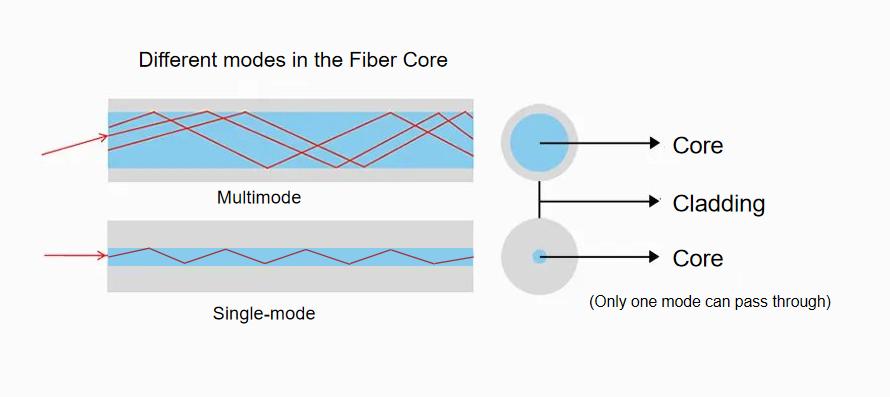
Single-Mode vs. Multi-Mode Fiber patch cord
When selecting a fiber patch cord, the key decision is whether to use single-mode or multi-mode, based on the type of devices, fiber cables, and transceivers in your network.
Single-Mode Fiber Patch Cords
Single-mode patch cords have a small core size (8-10 microns) and are used for long-distance connections. They are ideal for applications like telecom networks, data center interconnects, and Fiber-to-the-Home (FTTH) setups. Single-mode patch cords work with single-mode fiber cables and single-mode transceivers, providing low signal loss over long distances. Interestingly, single-mode patch cords themselves tend to be cheaper than multi-mode patch cords due to the simpler construction. But the overall system cost—including single-mode fiber cables and transceivers—tends to be higher.
Multi-Mode Fiber Patch Cords
In contrast, multi-mode patch cords have a larger core size (50-100 microns) and are better suited for shorter distances. These patch cords are commonly used in data centers and local area networks (LANs). They are ideal for connections within a single building or campus and are typically paired with multi-mode fiber cables and multi-mode transceivers. Multi-mode patch cords are generally more expensive than single-mode patch cords themselves because of the thicker fiber and specialized construction needed to support higher bandwidth at shorter distances.
Connector Polish: UPC vs. APC – Managing Reflections
Finally, the connector’s polish is a subtle but critical detail that controls light reflection. UPC (Ultra Physical Contact) connectors, often with blue bodies, have a curved, dome-shaped end. They provide excellent, low-loss connections for most digital data networks, including data centers and enterprise LANs.
However, for applications where even tiny light reflections cause major problems, you need APC (Angled Physical Contact) connectors. These are universally identified by their green bodies and have an end face polished at an 8-degree angle. This angle scatters any reflected light away, making APC connectors non-negotiable for analog systems like Cable TV (CATV) and Fiber-to-the-Home (FTTH) networks, where back-reflection creates signal noise and ghosting. A crucial warning: Never force an APC connector into a UPC port, or vice-versa. The mismatch can cause severe signal loss and physically damage the equipment.
Why Are Fiber Patch Cords Important?
Ensuring High-Speed Data Transfer
One of the primary reasons fiber patch cords are so important is their role in enabling high-speed data transfer. Fiber optic cables themselves are designed to transmit light signals at incredibly fast speeds, allowing for low-latency and high-bandwidth communication. Fiber patch cords help maintain this speed by providing a reliable, direct connection between network devices, ensuring that the data flow remains uninterrupted and efficient.
In environments like data centers, telecommunications infrastructure, and enterprise networks, even a slight delay or signal loss can lead to performance degradation. Fiber patch cords ensure that the integrity of the signal is preserved as it travels between devices such as routers, servers, and switches.
Scalability
As your network grows, fiber patch cords allow for flexible expansions and modifications. Because of their plug-and-play nature, technicians can easily add new devices, relocate connections, or make upgrades by simply swapping out or adding more patch cords. This modularity makes it simple to scale a network as demands increase, which is critical for businesses and service providers looking to keep up with growing data traffic and new technologies.
Durability
Fiber patch cords are designed to withstand environmental factors like temperature changes and physical stress. This makes them reliable for both indoor and outdoor installations. In industrial or outdoor installations—such as those in telecom towers, fiber optic networks in mining operations, or undersea cables—fiber patch cords ensure that the network remains operational despite harsh conditions. Their ability to maintain signal integrity in such environments further underscores their importance.
Conclusion
Fiber patch cords are an indispensable part of modern fiber optic networks. From connecting different devices to ensuring seamless data transmission, these cords play a crucial role in building efficient, high-performance networks. Whether you’re working on a simple home network or a massive enterprise system, fiber patch cords provide the flexibility, reliability, and speed required to keep your data flowing smoothly.


