
When you need to send video over a long distance, using fiber optic technology is one of the best choices. Copper cables like HDMI and SDI have their limits—both in distance and susceptibility to interference. Fiber can carry video, audio, and data signals very far without losing quality. To make this possible, we often use a device called a video fiber multiplexer 🎥🔗. This device allows many video signals to travel together inside one fiber optic cable, and then get separated back into individual signals at the receiving end.
But when you decide to make the leap to fiber, you’re faced with a crucial choice: a compressed or an uncompressed video fiber multiplexer. This isn’t just technical jargon; it’s a fundamental decision that impacts your video quality, latency, system cost, and flexibility.
Let’s break down the difference so you can choose the right tool for your job.

What is a Video Fiber Multiplexer?
A video fiber multiplexer is like a traffic manager for video signals. Imagine you have many video cameras, each producing its own video stream. Instead of needing one fiber cable for each camera, the multiplexer combines all the signals into a single fiber. At the other end, another multiplexer separates them again, so each video comes out just like it was before.
This is very useful in many areas:
- CCTV surveillance and security systems 🏢
- Traffic monitoring on highways and city roads 🚦
- Broadcasting for live events or TV studios 📺
- Industrial monitoring in factories 🏭
- Military and government security systems 🛡️
Now, the main difference comes down to how the multiplexer handles the video signals: compressed or uncompressed.
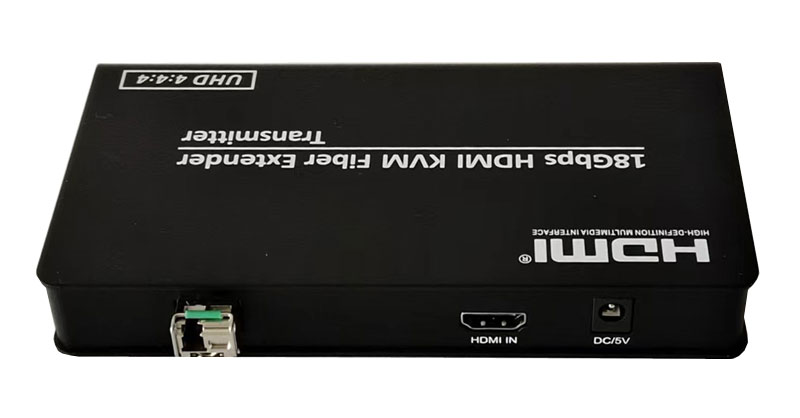
Uncompressed Video Fiber Multiplexer
The Uncompressed Video Multiplexer: Pure Fidelity, Zero Latency
An uncompressed fiber system takes the raw digital video signal and directly converts it into pulses of light. It doesn’t alter the data in any way. It simply provides a “bridge” for the pristine signal to travel across the fiber.
Key Characteristics:
- Video Quality:Perfect, bit-for-bit identical to the source. This is a true 1:1 representation.
- Latency:Extremely low, typically sub-microsecond. The delay is only the time it takes for light to travel the length of the fiber cable—essentially instantaneous for all practical purposes. Uncompressed has less than 1 ms of delay. It’s basically instant ⚡— great for live events or medical imaging where every frame matters
- Bandwidth Usage:Very high. It requires a fiber system with enough raw bandwidth to handle the massive data rate of an uncompressed video stream (e.g., a 4K60 4:4:4 signal can be over 12 Gbps).
- Complexity:Simpler processing. The system doesn’t need powerful chips to encode/decode, making the design more straightforward.
Best Use Cases for Uncompressed:
- Live Broadcast Production Switchers: Where frame-accurate switching and zero latency are critical.
- Medical Imaging (Surgery): Surgeons cannot afford any delay or any loss of detail when guiding instruments via a video feed.
- Professional Color Grading Suites:Absolute pixel perfection is required for critical color work.
- High-Frequency Financial Trading:Where every microsecond of latency counts.
Any application where the absolute integrity of the original signal is paramount.

Compressed Video Fiber Multiplexer
A compressed fiber system takes the raw video signal, processes it through a codec (like JPEG2000, H.264, or H.265/HEVC), and then sends this smaller, more efficient data package over the fiber. On the receiving end, it decodes the package back into a video signal.
Key Characteristics:
- Video Quality:“Visually lossless” to lossy. Visually lossless compression (e.g., JPEG2000) is a high-quality mode where the compression is so well-designed that the human eye cannot perceive any difference from the original, though technically, data is discarded. Lower-bitrate codecs (H.264) can introduce noticeable artifacts if set too aggressively.
- Latency:Noticeably higher. Latency can range from a few milliseconds for high-end codecs like JPEG2000 to hundreds of milliseconds or more for consumer-grade codecs like H.265. This is due to the time needed to encode and decode the video frames.(g.,JPEG2000 (Visually Lossless) adds only a few ms of delay. Still very fast and often “good enough” for monitoring 👌.)
- 264 Compression has a much bigger delay, around 70–80 ms. This can be noticeable, especially for live broadcasting, gaming, or any real-time communication 🎮🎤.
- Bandwidth Usage:Drastically lower. This is its superpower. A single fiber strand can carry multiple streams of 4K video, along with audio, control data, and Ethernet, because the video is packed so efficiently. (g., Through compression, a massive 12 Gbps 4K60 video signal can be slashed to a mere 15-50 Mbps, allowing a single fiber to carry dozens of streams instead of just one.)
- Complexity:More complex processing, requiring powerful encoding/decoding chips.
Best Use Cases for Compressed:
- Long-Distance Transport:Sending multiple video signals across a city or between campuses on existing fiber infrastructure.
- Multi-Signal Applications:Sending many camera feeds, confidence monitors, and data channels back to a central control room over a single fiber pair.
- Live Events & AV Integration:Where cabling runs are long and the flexibility to send numerous signals is key. The latency is often acceptable for viewing purposes.
- Digital Signage Networks:Distributing video content to numerous displays across a large facility.
- Security & Surveillance:Transporting multiple camera feeds to a central monitoring station, where maximizing the number of feeds is more important than zero latency.
Compressed vs. Uncompressed: Easy Comparison

| Feature | Compressed Multiplexer 📦 | Uncompressed Multiplexer 🎬 |
| Video Quality | Slightly lower, depends on compression | Perfect, no loss |
| Latency (Delay) | Small delay, but acceptable | Almost zero, real-time |
| Bandwidth Requirement | Low, many channels per fiber | High, fewer channels per fiber |
| Cost | Lower, more economical | Higher investment |
| Best For | CCTV, traffic, large networks | Broadcast, medical, mission-critical |
Imagine you need to move water across a city.
Uncompressed is like using a massive, dedicated pipeline. Every single drop of water (every pixel of data) arrives at the other end instantly and perfectly intact. It’s pure and unaltered, but that pipe is huge and expensive to build.
Compressed is like using a smaller, smarter pipe. You filter and cleverly pack the water to fit, then unpack it on the other side. It’s incredibly efficient and the water might look identical to the naked eye, but a tiny amount might be lost in the process, and the filtering/unfiltering takes a brief moment.
In technical terms, this “filtering” is the application of a codec (coder-decoder), and the “brief moment” is latency.

Conclusion
There is no “better” technology in a vacuum—only the right technology for your specific application.
- Uncompressed is the gold standard for purity and speed, acting as a perfect, invisible conduit for your signal. It’s the Formula 1 car of video transport.
- Compressed is the champion of efficiency and scalability, brilliantly balancing quality with practicality. It’s the fully-loaded cargo ship, moving massive amounts of data intelligently.
By understanding this fundamental difference, you can invest in a fiber solution that not only works but excels for your unique video transport needs.


