
As fiber optic networks continue to expand in data centers, enterprise campuses, FTTH deployments, and telecom infrastructure, selecting the right fiber patch panel types becomes increasingly important. A well-designed patch panel not only organizes fiber connections but also protects delicate optical fibers, simplifies maintenance, and allows future network expansion.
Whether you’re building a new fiber network or upgrading an existing installation, understanding the differences between a fiber patch panel cassette, a fiber optic patch panel rack mount, and a fiber patch panel enclosure can help you make the right investment.
In this guide, we’ll explain the most common fiber patch panel types, their advantages, typical applications, and how to choose the best option for your project.
- What Is a Fiber Patch Panel?
- Overview of Common Fiber Patch Panel Types
- How to Choose the Right Fiber Patch Panel Type
- Frequently Asked Questions

What Is a Fiber Patch Panel?
A fiber patch panel is a hardware device used to terminate, organize, manage, and distribute fiber optic cables. It provides a centralized location where backbone fiber cables connect to patch cords, making network management much easier.
A typical fiber patch panel includes:
- Fiber adapters (LC, SC, ST, FC, MPO)
- Splice trays
- Cable management accessories
- Cable entry points
- Front access ports
- Rear cable routing
Instead of having loose fiber cables throughout a rack, patch panels create a clean and structured cabling system that improves reliability and simplifies troubleshooting.
Overview of Common Fiber Patch Panel Types
| Patch Panel Type | Best For | Typical Capacity |
| Rack Mount Patch Panel | Data centers, telecom rooms | 12–144+ fibers |
| Wall Mount Patch Panel | Small offices, FTTH | 4–48 fibers |
| Fiber Patch Panel Cassette | High-density modular systems | 12–24 fibers per cassette |
| Fiber Patch Panel Enclosure | Splicing and cable protection | 12–288 fibers |
| Sliding Rack Mount Panel | Frequent maintenance | 24–96 fibers |
| Fixed Rack Mount Panel | Stable installations | 12–48 fibers |
1. Fiber Optic Patch Panel Rack Mount
The fiber optic patch panel rack mount is the most widely deployed solution in structured fiber networks. It is designed to fit into standard 19-inch racks and is commonly used in enterprise and carrier-grade environments.
This type of patch panel acts as a centralized fiber termination point where multiple incoming backbone cables are organized and distributed to outgoing patch cords.
Key Features
- High-density fiber management: Rack mount panels can support dozens to hundreds of fibers within a single unit, making them ideal for environments where space efficiency is critical.
- Standard rack compatibility: They are designed to fit seamlessly into industry-standard racks, allowing easy integration with switches, OLTs, and optical transmission equipment.
- Structured cabling organization: Internal routing systems ensure fibers are neatly separated, reducing signal interference risk caused by tight bending or crossing cables.
- Front-access design: Technicians can manage connections from the front without disturbing rear cabling, significantly improving maintenance speed.
- Flexible port configuration: Supports LC, SC, and MPO adapters depending on application requirements.
2. Wall Mount Fiber Patch Panels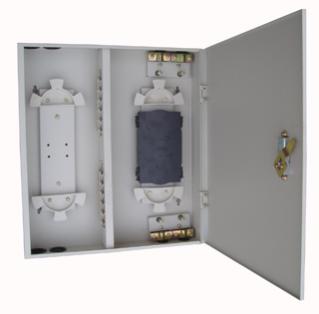
For smaller network deployments, remote locations, or spaces where a rack isn’t available, wall mount panels are an excellent alternative that offers surprising versatility. These fiber patch panel enclosure units are directly attached to a wall and provide a compact, cost-effective solution for managing fiber terminations in environments where floor space is too limited for a full-sized cabinet. They are ideal for installations with under 50 drops, such as in retail stores, branch offices, or school classrooms, helping to protect sensitive fiber connections from dust, accidental bumps, and environmental damage in a secure, lockable enclosure.
Many wall mount enclosures also come with integrated splice trays and slack storage spools, allowing technicians to neatly coil and secure excess fiber within the box itself. This internal management is critical because it ensures that the fiber bend radius is never compromised, preventing micro-bends that can cause significant signal attenuation over time. By housing all terminations and splices in one protected box, these wall units keep the installation tidy while providing a clear demarcation point between the outside plant cabling and the internal network equipment.
3. Fiber Patch Panel Cassette
A fiber patch panel cassette is a modular fiber management unit designed to be inserted into compatible patch panel housings or enclosure systems. Instead of installing a fully integrated panel, operators can deploy multiple small, independent cassettes.
Each cassette typically contains pre-terminated fibers, adapters, and internal routing structures.
Key Advantages
Modular Architecture
Each cassette operates as an independent fiber module. This means network engineers can scale capacity incrementally instead of replacing entire patch panels. It is especially useful in fast-growing networks where demand changes frequently.
Faster Deployment
Since many cassettes are factory-terminated and pre-tested, installation time is significantly reduced. This minimizes onsite splicing work and reduces the risk of human error during installation.
Simplified Maintenance
If a fault occurs within a module, technicians can replace only the affected cassette instead of shutting down the entire panel. This reduces downtime and improves network reliability.
High Flexibility
Different cassette types can be mixed within the same system, such as:
LC duplex for high-density connections
MPO cassettes for backbone aggregation
SC cassettes for legacy compatibility
This flexibility supports hybrid network evolution.
4. Fiber Patch Panel Enclosure
A fiber patch panel enclosure is a protective housing system that contains fiber termination components such as adapters, splice trays, and cassettes. It acts as the structural foundation that ensures fiber components are physically protected and properly organized.
Unlike rack panels, enclosures focus more on protection and environmental control.
Main Function
- Physical protection: Shields delicate fiber components from dust, vibration, and accidental impact.
- Cable strain relief: Prevents stress on fiber cables caused by pulling or bending during installation or maintenance.
- Bend radius control: Maintains minimum bend radius standards to avoid signal loss or fiber breakage.
- Environmental isolation: Outdoor versions protect against moisture, temperature changes, and UV exposure.
- Structured routing paths: Internal guides ensure fibers are routed in a controlled and organized manner.
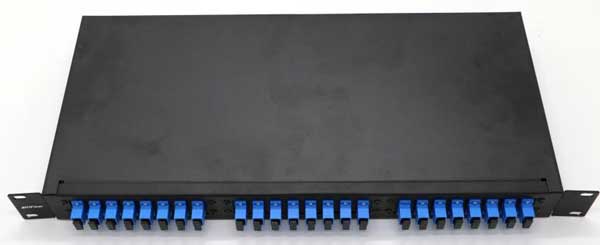
5. Sliding Fiber Patch Panels
Sliding fiber patch panels are designed with telescopic rails that allow the entire tray to extend outward from the rack. This provides technicians with direct access to both front and rear fiber terminations.
Advantages

Easier rear fiber access reduces installation difficulty
Improves safety during splicing or rearrangement
Reduces strain on connected fibers during maintenance
Allows faster troubleshooting in high-density racks
Sliding systems are especially useful in environments where frequent changes or upgrades are expected.
6. Fixed Fiber Patch Panels
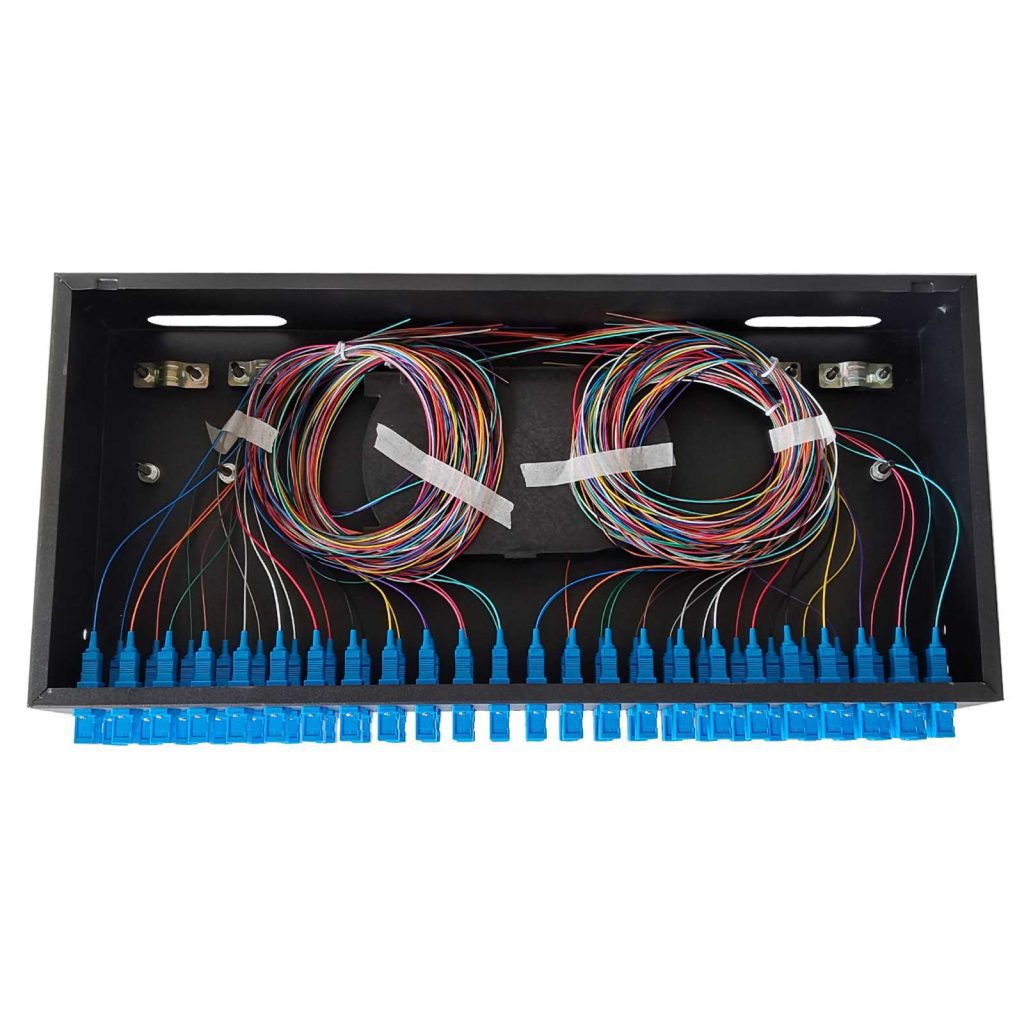
SC Fixed Type 48Port ODF Fiber Patch Panel
Fixed panels are permanently mounted within the rack and do not move during operation. They offer a simple, stable, and cost-effective fiber management solution.
Advantages
Lower manufacturing and deployment cost
High mechanical stability due to fixed structure
Fewer moving parts means higher long-term reliability
Compact and space-efficient design
Fixed panels are best suited for stable networks where changes are infrequent.
How to Choose the Right Fiber Patch Panel Type
Choosing the right fiber patch panel is about more than simply selecting a panel that fits your rack. The ideal solution should match your current network requirements while also providing enough flexibility to accommodate future expansion. Factors such as fiber count, connector compatibility, installation environment, maintenance needs, and scalability all play an important role in ensuring long-term network reliability and cost efficiency.
1. Consider Fiber Count
The first step is determining how many fiber connections your network requires today and how many it may need in the future. Choosing a panel with insufficient capacity can lead to expensive upgrades, while an oversized panel may waste valuable rack space.
As a general guideline:
Small offices and branch networks: 12–24 fibers
Enterprise LANs and campus networks: 48–96 fibers
Large data centers and telecom facilities: 144–288+ fibers
It’s also important to consider future growth. For example, if your business plans to expand its network infrastructure, add new servers, or migrate to higher-bandwidth applications, selecting a larger panel or a modular system now can eliminate the need for replacing the entire patch panel later.
2. Choose the Right Adapter Type
Fiber patch panels are available with different adapter interfaces, and the correct choice depends on the type of connectors used in your network.
Common connector options include:
LC – The most popular choice for modern data centers due to its small size and high-density capability.
SC – Widely used in FTTH, GPON, and telecom access networks because of its durability and simple push-pull design.
FC – Often found in testing equipment and industrial environments where threaded connections provide extra security.
ST – Common in some legacy enterprise and industrial fiber installations.
MPO/MTP® – Designed for ultra-high-density applications and parallel optical transmission in 40G, 100G, 200G, and 400G Ethernet networks.
For most new enterprise deployments, LC duplex adapters provide an excellent balance of density and ease of use. If your network is expected to support high-speed backbone links or cloud computing infrastructure, MPO/MTP connectivity is often the preferred choice because it simplifies migration to higher bandwidths.
3. Consider the Installation Location
Where the patch panel will be installed has a significant impact on the type of enclosure you should choose.
Indoor installations generally use:
Rack-mounted patch panels for server rooms and data centers
Wall-mounted panels for small offices, wiring closets, and FTTH distribution points
These environments are relatively clean and climate-controlled, so standard enclosures are usually sufficient.
Outdoor installations, however, require much greater protection. In these situations, a sealed fiber patch panel enclosure with an appropriate IP rating (such as IP65 or IP66) is recommended. Outdoor enclosures protect fiber connections from rain, dust, UV exposure, humidity, and temperature fluctuations while also providing secure cable entry and strain relief.
Selecting an enclosure that matches the installation environment helps extend the lifespan of both the patch panel and the fiber cables it protects.
4. Evaluate Maintenance Requirements
Not all networks require the same level of maintenance. Some installations remain unchanged for years, while others undergo frequent upgrades, moves, or reconfigurations.
If technicians regularly add, remove, or reroute fiber connections, choosing a patch panel designed for easy access can significantly reduce maintenance time.
Good options include:
Sliding fiber patch panels, which allow the tray to slide forward for easy access to rear fiber connections without removing the panel from the rack.
Modular fiber patch panel cassette systems, where individual cassettes can be installed, replaced, or upgraded independently.
These designs simplify troubleshooting, reduce the risk of accidentally disturbing adjacent fibers, and minimize network downtime during maintenance. Although they may have a higher initial cost than fixed panels, they often lower long-term operating expenses by making future service work faster and more efficient.
Frequently Asked Questions
What are the main fiber patch panel types?
The most common fiber patch panel types include rack mount patch panels, wall mount panels, sliding panels, fixed panels, modular cassette systems, and fiber patch panel enclosures. Each type is designed for different installation environments and fiber capacities.
What is a fiber patch panel cassette?
A fiber patch panel cassette is a modular fiber module containing adapters and internal fiber routing. It installs into compatible enclosures and allows quick deployment, easy maintenance, and scalable expansion without replacing the entire patch panel.
What is a fiber optic patch panel rack mount used for?
A fiber optic patch panel rack mount is designed for installation in standard 19-inch equipment racks. It is commonly used in data centers, enterprise networks, and telecom rooms to organize, terminate, and manage high-density fiber optic connections.
What does a fiber patch panel enclosure do?
A fiber patch panel enclosure protects fiber cables, splice trays, adapters, and cassettes from physical damage while providing organized cable routing, bend radius protection, and easier maintenance. Enclosures are available for indoor and outdoor applications.
Which patch panel type is best for future expansion?
Modular cassette-based systems are generally the best choice for growing networks because they allow additional cassettes to be added as capacity increases, reducing upgrade costs and minimizing downtime.
Conclusion
Understanding the different fiber patch panel types is essential for designing a reliable, organized, and scalable fiber optic network. Whether you need a fiber optic patch panel rack mount for a data center, a modular fiber patch panel cassette for high-density deployments, or a rugged fiber patch panel enclosure to protect critical fiber connections, selecting the right solution can improve network performance, simplify maintenance, and support future growth.
By considering fiber capacity, connector compatibility, installation environment, and expansion requirements, you can build a structured cabling system that remains efficient and easy to manage for years to come.


