
What Is Drop Cable?
Let’s start with the drop cable meaning. A drop cable is the final section of a fiber optic network that connects the main line on the street to the user’s home, office, or building. Think of it as the “last mile” of the fiber network — the part that brings the signal directly to you.
A fiber optic drop cable carries light signals that deliver your internet, TV, and voice services. It’s small, flexible, and made to handle outdoor environments like poles, walls, and underground ducts. Without drop cables, there would be no way to bring the main network’s fiber connection right into your building.

Structure of a Fiber Optic Drop Cable
A fiber optic drop cable might look simple from the outside, but inside it’s built with several layers for protection and performance. Here’s what’s inside:
- Optical Fiber Core:This is the heart of the cable. It’s a thin glass strand that carries light signals to transmit data. Most drop cables use special bend-insensitive fibers (like G.657A1 or G.657A2), so they can be installed easily even around corners.
- Strength Members:These are thin rods or wires, often made from FRP (Fiber Reinforced Plastic) or steel, placed beside the fiber to make the cable stronger and prevent it from stretching or breaking.
- Buffer Layer:A soft layer (you might know it as Kevlar®, the stuff in bulletproof vests!) that wraps around the fiber to protect it from moisture, impact, and temperature changes.
- Outer Jacket:The final protective layer, made from materials like PE (Polyethylene) for outdoor use or LSZH (Low Smoke Zero Halogen) for indoor use. It keeps the cable safe from rain, sunlight, extreme temperatures, and even curious animals!

drop cable cross section
Common Types of Fiber Drop Cables
Not every home is the same, so technicians use different types of drop cables depending on the situation. Here are the most common ones:
Figure-8 Aerial Cable
- What it looks like:A cable shaped like the number “8”.
- Best for:Running from a telephone pole to your house.
- Why? The top part of the “8” is a strong steel wire that holds the weight of the entire cable across the open air. The bottom part is the actual fiber cable.
Flat Drop Cable
- What it looks like:A thin, flat, ribbon-like cable.
- Best for:Being tucked neatly along the walls of your house, under carpets, or around door frames. It’s less noticeable and very flexible.
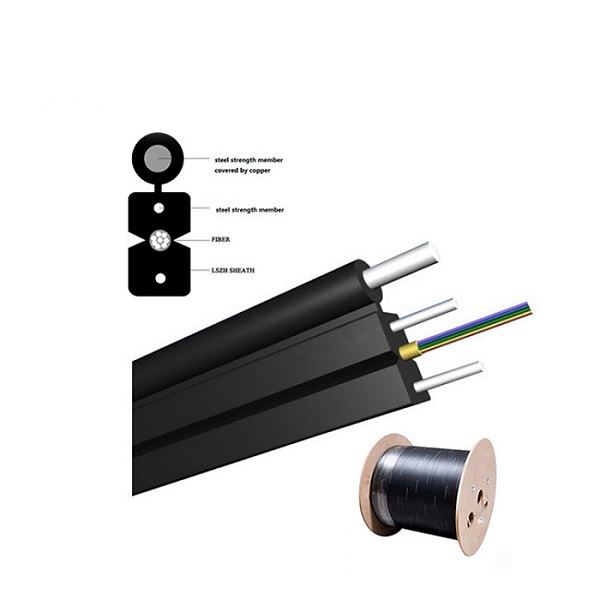
flat fiber drop cable
Round Buried Cable
- What it looks like:A standard, round cable.
- Best for:Being pulled through underground pipes (conduits) or buried directly in the ground. Its round shape provides strong, all-around protection from dirt and pressure.
Armored Drop Cable
- What it looks like:A heavy-duty cable, often with a corrugated metal layer inside.
- Best for:Areas with lots of rodents or where there’s a risk of the cable being crushed. The metal armor acts like a shield for the delicate fiber inside.
Applications of Fiber Optic Drop Cable
The main job of a fiber optic drop cable is to connect homes for FTTH (Fiber-to-the-Home). But its uses don’t stop there!
Your House! 🏡: This is the most common use. Connecting a single-family home to the internet.
Apartment Buildings 🏢: Running fiber from a main box in the basement to each individual apartment.
Businesses and Offices 💼: Providing super-fast and reliable internet for companies.
Cell Phone Towers 📶: Connecting the tower to the main network to handle all your mobile data.
Security Systems 🎥: Linking high-quality, internet-based security cameras that need a lot of bandwidth.
In all these cases, the drop cable ensures fast, reliable, and low-loss transmission between the main line and the user — making it a vital part of every fiber network.
Conclusion
Now you know the drop cable meaning, structure, and the many types used in modern fiber networks. A fiber optic drop cable may seem small, but it plays a huge role in connecting you to the digital world.
Whether it’s for FTTH, FTTB, or FTTO, these cables ensure that high-speed data, voice, and video signals reach your home or business quickly and reliably.
Related Article: Fiber Optical Cable: The Ultimate Guide


