
In today’s fast-moving digital world, data travels across long distances through optical fiber cables. These cables carry light signals instead of electrical signals, which allows faster and more efficient communication. However, when light travels long distances, it loses strength—this is where an optical amplifier EDFA, or Erbium-Doped Fiber Amplifier, plays a very important role. It helps boost weak signals so they can continue traveling over long distances without being lost.
This blog will explain what an EDFA is, how it works, and where it is used. We’ll keep the language simple and give real examples, so it’s easy to understand even if you are not an expert in fiber optics.

What is an EDFA?
An EDFA is a type of device used in optical communication systems to amplify light signals. It is especially useful in fiber optic networks, where data is sent using light. Over long distances, this light signal becomes weaker. To fix that, an EDFA boosts the signal without changing it into an electrical signal, which makes the process faster and more efficient.

what is an edfaz (erbium doped fiber amplifierz)
Erbium-Doped: This refers to the core ingredient. A specific section of the optical fiber is “doped” (infused) with atoms of the rare-earth element Erbium (Er).
Fiber: It uses standard optical fiber as its platform, making it compatible with existing fiber optic networks.
Amplifier: Its sole purpose is to take weak incoming optical signals and make them stronger (amplify them) without converting them back to electrical signals first.
Why EDFA Was a Breakthrough
Before optical amplifier EDFA were invented in the late 1980s and early 1990s, signal amplification in fiber networks had to be done using a three-step process: convert the optical signal into an electrical signal, boost it, and then change it back to optical. This process was slow, expensive, and not very efficient.
Before EDFAs, boosting signals over long distances was a major headache. Here’s why:
Weak optical signals had to be converted back into electrical signals. The electrical signal was then amplified using traditional electronic amplifiers. The amplified electrical signal was finally converted back into an optical signal to continue its journey down the fiber. This process (Optical->Electrical->Optical, or O-E-O) was slow, expensive, complex, and limited by the speed of the electronics. It was the bottleneck for high-speed, long-distance fiber networks.

EDFA changed everything. It allowed for direct optical amplification, which means the light signal is made stronger without converting it to electricity. This reduced equipment costs, increased speed, and made it possible to build longer fiber links without using many expensive regenerators. Because of EDFA, modern internet and telecommunication systems could grow rapidly and support massive amounts of data over long distances.
How Does an EDFA Work?
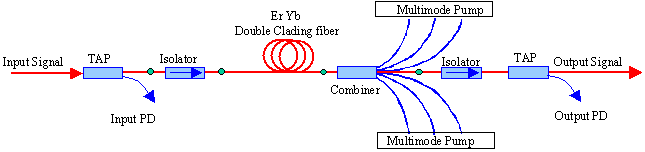
Understanding How EDFA works is not too hard. Inside an EDFA, there is a short piece of special fiber that contains erbium. When light carrying data enters this fiber, it needs extra energy to get amplified. This energy comes from a pump laser, which shines a different light (usually at 980 nm or 1480 nm) into the fiber.
This pump light excites the erbium atoms, putting them in a high-energy state. When the weak signal passes through, it causes the excited erbium atoms to release their energy by emitting new light photons. These new photons are exactly the same as the signal photons, so the signal becomes stronger. This process is called stimulated emission.
To work well, EDFA designs need to consider how much erbium is used, the type of pump laser, and the fiber length. Newer designs also add other materials like aluminum or germanium to improve performance, reduce noise, and make the amplification smoother across all wavelengths.
Different Types of EDFAs
There are several types of EDFAs used in different parts of a fiber optic network:
-
Booster EDFA:
This type is placed just after a transmitter. It takes the original signal and boosts it to a higher power level so it can travel farther through the fiber. Think of it like shouting louder at the beginning so your voice can travel further. This helps ensure that the signal doesn’t weaken too quickly as it moves down the fiber.
-
Inline EDFA:
This is used in the middle of a long fiber route. It boosts the signal at regular distances to keep it strong throughout the journey. As light travels through fiber, it loses strength due to distance and fiber losses. Inline EDFAs are installed at intervals—like “rest stops” for the signal—where they boost it back to full strength before continuing. This keeps the data signal clean and readable, even after traveling a great distance.
-
Pre-Amplifier EDFA:
This is placed just before the receiver. It helps make very weak incoming signals stronger so the receiver can read the data properly. When a signal finally reaches the end of the fiber, it is often very weak. A pre-amplifier gives the signal a final boost so the receiver can properly detect and decode the data. This type of EDFA is especially useful in systems where the incoming signals are very faint, such as in undersea cables or long metro networks.

There are also more advanced types of EDFAs used in modern networks:
- Gain-Flattened EDFA (GF-EDFA): In many networks today, especially those using DWDM (Dense Wavelength Division Multiplexing), multiple channels of data are sent over a single fiber, each using a slightly different wavelength (color) of light. A problem can occur if some wavelengths get amplified more than others. The GF-EDFA solves this by evenly amplifying all channels, keeping the signal balanced and preventing distortion between channels.
- Dual-Stage EDFA: As the name suggests, it uses two amplifier stages inside one unit. This allows better control over both the signal gain and the noise figure. The first stage provides strong amplification, and the second stage helps reduce noise and fine-tune the output. This makes it ideal for sensitive applications where signal clarity is critical.
- Raman-Assisted EDFA: These combine traditional EDFA technology with Raman amplification, which amplifies the signal over the entire length of the fiber, not just at specific points. Raman-assisted EDFAs can reduce noise and improve the performance of ultra-long fiber links, such as in transoceanic communication systems. They offer better signal quality, but they are more complex and expensive.
Where Are EDFAs Used?
EDFAs are the workhorse optical amplifiers in virtually all long-distance and high-capacity fiber optic communication systems:
Long-Haul & Submarine Networks: Amplifying signals across continents and under oceans.
Metro & Regional Networks: Connecting cities and data centers over moderate distances.
Dense Wavelength Division Multiplexing (DWDM): Amplifying dozens or hundreds of different wavelength channels simultaneously without needing separate amplifiers for each channel – this is where their transparency is indispensable. (Why is EDFA used in DWDM? Primarily for this simultaneous multi-wavelength amplification capability).
Cable Television (CATV) Networks: Boosting signals for distribution.
Fiber-to-the-Home (FTTH) Backbone: Extending reach in access networks.
What to Consider When Choosing an EDFA
If you are planning to use EDFAs in a project, here are some important points to consider:
Input and Output Power Range: Make sure the amplifier can handle the signal levels you need.
EDFAs amplify all light signals within their operating bandwidth (typically the “C-band” ~1530-1565nm or “L-band” ~1565-1625nm) simultaneously, regardless of the data rate or modulation format.
Gain and Noise Figure: Look for a high gain (e.g., 20–30 dB) with a low noise figure (less than 5 dB) for the best quality.
Flatness of Gain: If you are using DWDM (multiple channels), check if the gain is even across all wavelengths.
Remote Management: Modern EDFAs offer monitoring through web interfaces, SNMP, or CLI—useful for managing many devices in the field.
Reliability: For critical systems like submarine or backbone networks, choose EDFAs with redundant pump lasers and built-in alarms.
Final Thoughts
What is an EDFA? EDFA is one of the most important inventions in the world of fiber optics. It allows data to travel long distances quickly, efficiently, and with high quality. Without EDFA, global internet and communication systems as we know them would not be possible.
Reference:
https://www.baudcom.com.cn/blog/the-application-of-erbium-doped-fiber-amplifier-edfa
https://www.baudcom.com.cn/blog/erbium-doped-fiber-amplifier-edfa-html


