
Fiber optic patch cords are the backbone of modern high-speed networks, connecting equipment and enabling data transmission across data centers, telecom networks, and enterprise infrastructure. At the heart of every fiber connection lies the connector, and two of the most widely used types are LC and SC. Choosing between SC and LC patch cable is a decision that directly impacts your network’s performance, scalability, and long-term operational costs. This guide will break down the Difference between LC and SC patch cord—from physical design to real-world applications—to help you make the right choice for your specific needs.
Table of Contents
- What is an LC Patch Cord?
- What is an SC Patch Cord?
- LC vs. SC: Direct Comparison
- How to Choose Between LC and SC?
- Installation Best Practices for Both Connectors
- When You Need Both: SC to LC Hybrid Patch Cables
1. What is an LC Patch Cord?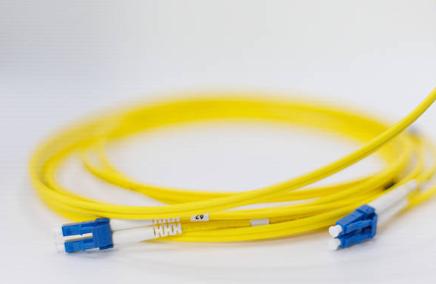
What is LC patch cord full form? LC stands for Lucent Connector (often called “Little Connector” for its compact size). It is the industry-standard connector for modern data centers and high-density enterprise networks.
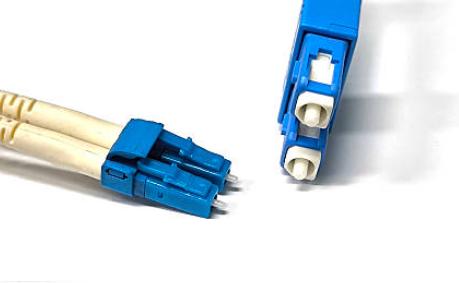
The LC connector uses a 1.25 mm ferrule — half the diameter of the SC’s 2.5 mm ferrule. It features a latch locking mechanism (similar to an RJ45 Ethernet plug) that clicks securely into place and prevents accidental disconnection.
Key Features of LC Patch Cords
- 25 mm ferrule: Smaller than the 2.5 mm SC ferrule, making LC ideal for dense installations.
- Compact design: An LC connector occupies approximately half the space of an SC connector.
- Latch locking mechanism: Helps prevent accidental disconnection.
- High-density connectivity: More LC connections can be installed within limited rack and panel space.
- Common equipment interface: Widely used with SFP and SFP+ optical transceivers.
2. What is an SC Patch Cord?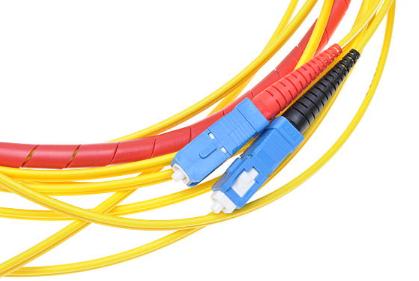
SC stands for Subscriber Connector (also called Standard Connector or Square Connector). It is a full-size connector with a 2.5 mm ferrule and a simple push-pull locking mechanism — just push to connect, pull to release.
SC connectors are physically larger than LC, which makes them easier to grip and install, especially in field environments where technicians wear gloves or work in tight spaces.
Key Features of SC Patch Cords
- 5 mm ferrule: A larger ferrule than LC.
- Push-pull locking: Provides straightforward connection and removal.
- Simple handling: The larger connector body can be easier to grip during installation.
- Proven reliability: SC connectors are widely used in telecommunications and fiber access networks.
- Long service life: Properly maintained SC connectors can support a high number of mating cycles.
3. LC vs. SC: Direct Comparison
The following table summarizes the main differences between LC and SC patch cord designs:
| Decision Factor | LC Patch Cord | SC Patch Cord | What This Means for YOU |
| Ferrule Size | 1.25 mm | 2.5 mm | LC is half the size — more ports per rack |
| Port Density (per 1U) | ~48 ports | ~24 ports | LC doubles your capacity in the same space |
| Locking Mechanism | Latch (RJ45-style) | Push-pull | LC is secure; SC is simpler and more forgiving |
| Equipment Compatibility | SFP/SFP+/QSFP transceivers | ONT/OLT (GPON/FTTH) | Your equipment dictates your choice |
| Handling Difficulty | More precise, delicate | Easy, works with gloves | SC is better for field installations |
| Relative Cost | Higher | Lower | SC saves money on large deployments |
| Future-Proofing (400G/800G) | Fully supported | Rarely used | LC is the safer long-term investment |
4. How to Choose Between LC and SC?
Choosing between LC and SC should not be based only on connector size. The interface on your equipment and the architecture of your network should be the first considerations.
Choose LC When:
- Space is limited
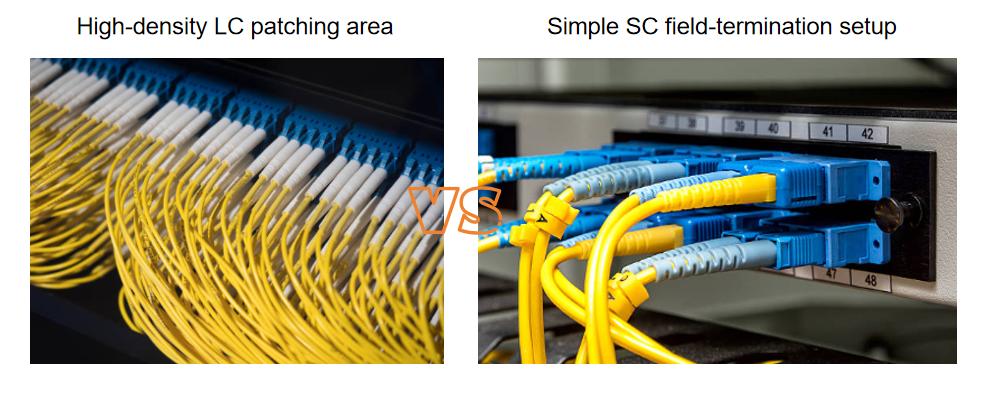
LC is an excellent choice for high-density racks and patch panels because its compact design allows more fiber connections to fit into a smaller area.
- You are using SFP, SFP+, or similar transceivers
Many Ethernet switches and optical transceivers use LC interfaces. If your switch or transceiver has an LC port, an LC patch cord is normally the appropriate choice.
- You are building a modern data center or cloud network
Data centers often require large numbers of fiber connections in a limited rack footprint. LC’s small form factor helps improve port density and cable management.
- You are preparing for higher network speeds
High-density LC connectivity is widely used in modern optical networking equipment. Choosing LC can make it easier to maintain a compact cabling architecture as network capacity grows.
Choose SC When:
- You are deploying FTTH, GPON, or EPON
SC connectors are widely used in fiber access networks and PON infrastructure. If your OLT, ONU/ONT, splitter, or distribution equipment uses an SC interface, an SC patch cord is the straightforward choice.
- Ease of handling is important
The larger SC connector body is easy to grip, making it convenient for field installation and maintenance.
- Your existing infrastructure uses SC interfaces
Replacing an established SC-based infrastructure simply to use LC connectors may create unnecessary compatibility and cabling issues. In this situation, continuing with SC is often more practical
- Cost is a major consideration
SC-based fiber connectivity can be a cost-effective choice for many access-network deployments, particularly where extremely high port density is not required.
In short, LC is generally preferred for compact, high-density environments, while SC remains a practical choice for many telecom and FTTH applications.
5. Installation Best Practices for SC LC patch cables
Regardless of which connector you choose, following proper installation practices is critical for maintaining signal integrity and long-term performance.
Bend Radius Requirements
Exceeding the minimum bend radius causes signal loss and potential fiber damage. A general guide: 30mm for standard 3.0mm jacket cables, 15mm for thinner cords. For dynamic applications, maintaining at least 20mm is recommended.
Cable Management
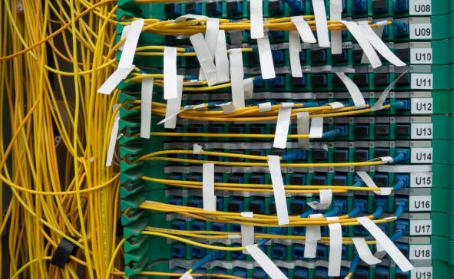
Avoid over-tightening zip ties. Use proper cable management systems to prevent crushing or kinking. High-density environments require careful labeling and organization to avoid congestion.
Cleaning Protocols
Contamination is a leading cause of insertion loss. Recommended practice: inspect connectors before each use and wipe ferrules in one direction using dedicated fiber cleaning tools. Monthly inspection schedules are common in enterprise environments.
Labeling Every Cord
Document the start and end points of each patch cord. In high-density panels, this prevents accidental disconnections and simplifies troubleshooting.
6. When You Need Both: SC to LC Hybrid Patch Cables
Not every network uses the same connector type at both ends. This is where an SC LC patch cable, also called an SC-to-LC hybrid patch cord, becomes useful.
An SC-to-LC patch cable has an SC connector on one end and an LC connector on the other. It allows equipment with different connector interfaces to be connected without replacing the existing fiber infrastructure.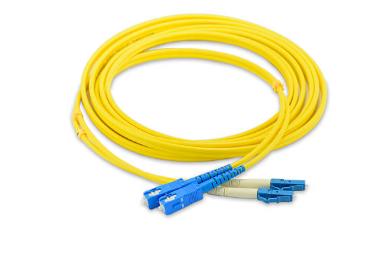
For example:
LC interface on switch/transceiver → LC connector → Fiber patch cable → SC connector → SC patch panel
This configuration is particularly useful when the equipment side uses compact LC interfaces while the existing distribution or patching infrastructure uses SC interfaces.
However, connector type alone does not determine compatibility. You should also verify the fiber type, single-mode or multimode specification, polish type, connector gender, insertion loss, and required cable length before ordering an SC-to-LC patch cable.
7. Conclusion
Understanding the difference between LC and SC patch cords make it easier to select the right fiber connection for your network.
LC connectors use a compact 1.25 mm ferrule and are well suited to high-density applications such as data centers, optical switches, and SFP/SFP+ transceivers. SC connectors use a larger 2.5 mm ferrule and remain widely used in FTTH, GPON, EPON, telecommunications, and other access-network applications.
The basic rule is simple:
Choose LC for high-density and space-constrained networks.
Choose SC for many FTTH, PON, and telecom applications.
Choose SC-to-LC hybrid patch cables when your equipment and infrastructure use different connector types.
Most importantly, always match the patch cord to the actual interface and optical requirements of your equipment. The correct connector, fiber type, polish, and installation practices together ensure stable and reliable fiber optic network performance.


