
In the field of telecommunication and data communication systems, monitoring and control interfaces often rely on contact signals. Among the most common types are dry contacts and wet contacts—two terms that describe how electrical circuits communicate status information. Understanding the dry contact and wet contact difference is essential for proper system integration, especially in alarm monitoring, remote control, and industrial automation applications.
Core Concept
It’s All About the Power Source
The fundamental difference between a dry contact and wet contact boils down to one simple question: Does the contact itself provide voltage?
Imagine a simple switch on your wall at home. When you flip it, the two metal contacts inside either touch (closing the circuit) or separate (opening the circuit). That switch doesn’t generate electricity; it just controls a circuit that is powered from elsewhere (your electrical panel). This is the perfect analogy for a dry contact.
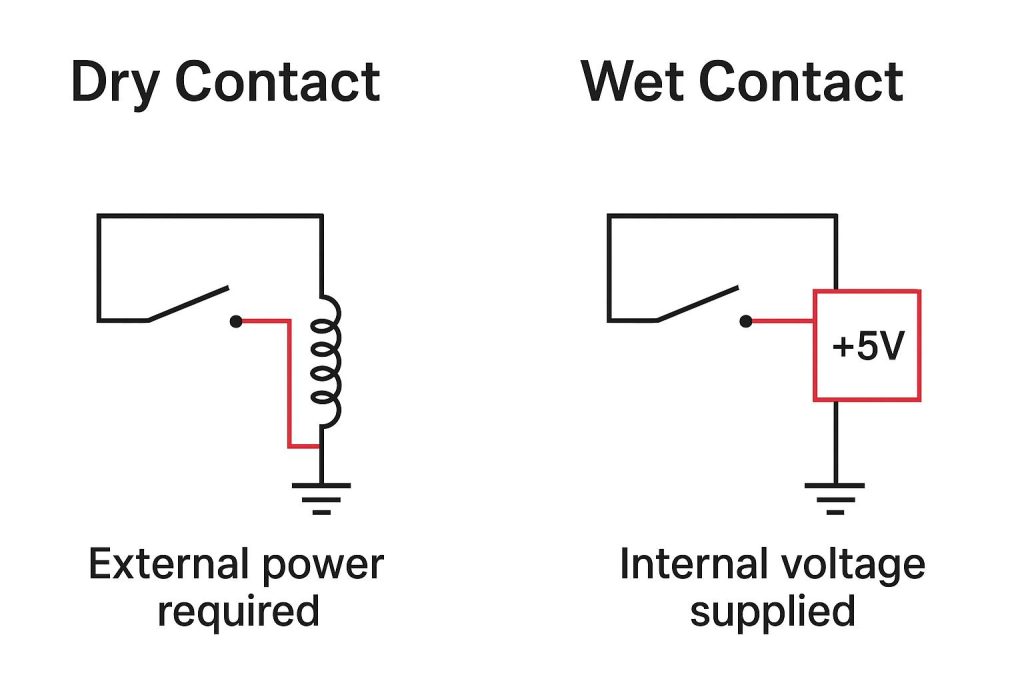
What is Dry Contact and Wet Contact?
Dry Contact Explained
A dry contact, also known as a potential-free contact, is a simple switch that operates without any external voltage or current supplied by the device itself. Instead, it works purely as a mechanical relay connection that opens or closes a circuit.
In other words, a dry contact only provides a conductive path; it does not output any power. The external monitoring or control equipment must provide its own reference voltage to detect whether the contact is open or closed.
How Dry Contacts Work
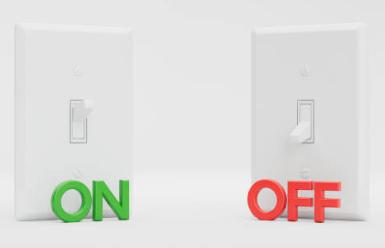
A dry contact is essentially a relay. It’s an isolated pair of contacts that are operated by an external force (like a sensor tripping, a button being pressed, or a device sending a command).
Closed Circuit (ON): The two contacts touch, completing a path for a signal or power from an external source to flow.
Open Circuit (OFF): The two contacts separate, breaking the path and stopping the flow.
Real-World Example: A door/window security sensor. The sensor itself is just a magnetic switch (a dry contact). When the door is closed, the circuit is closed. When the door opens, the circuit opens. The alarm panel is what provides the voltage and monitors this dry contact to know if the door is open or closed. The sensor doesn’t output any voltage of its own.
What Is a Wet Contact?
A wet contact, on the other hand, does have voltage supplied directly from the source device. The “wet” signifies that the contacts are “wet” with power. It’s not just a switch; it’s a powered output.
How Wet Contacts Work:
A wet contact provides both the switching action and the power source. When the contact closes, it delivers a voltage (e.g., 24V DC, 48V DC) from the source device to the receiving device.
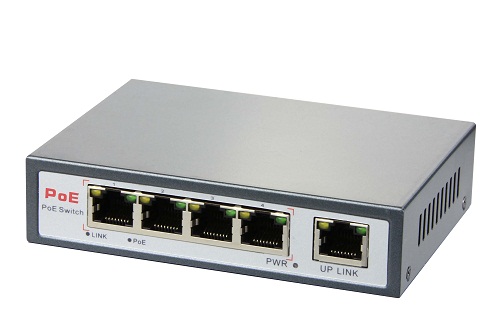
Real-World Example: A Power over Ethernet (PoE) switch port. The port not only provides the data connection but also “wets” the line with 48V DC to power the connected phone or access point. Another example is the auxiliary power output from a router or a controller that sends both a control signal and operating voltage to another device.
Dry Contact vs Wet Contact: The Key Differences
| Feature | Dry Contact | Wet Contact |
| Electrical Source | No voltage or current (voltage-free) | Has voltage/current supplied by the device |
| External Power Required | Yes, external monitoring circuit provides voltage | No, device provides voltage |
| Safety | Safer for system interconnection | Requires attention to voltage compatibility |
| Typical Use | Alarm relay output, signal isolation | Self-powered signal indication, control output |
| Example | Relay output with no voltage | TTL signal or 12V alarm output |
The dry contact and wet contact difference mainly lies in whether the output carries electrical potential. In telecommunications, knowing this distinction ensures proper integration between network devices, alarms, and monitoring systems—preventing signal misinterpretation or hardware damage.
Conclusion
Understanding what is dry contact and wet contact is crucial in telecommunication systems where reliability and safety are paramount. Dry contacts offer isolation and flexibility, while wet contacts provide convenience and self-powered signaling.
When designing or integrating telecom infrastructure, always verify contact types to ensure signal compatibility and protect connected equipment.
Baudcom’s range of communication products supports both dry contact and wet contact configurations—enabling seamless monitoring and control for your network systems.


