
The PLC splitter is one compact yet effective tool that improves the performance of these networks. Imagine a single highway lane smoothly splitting into many smaller roads, guiding cars efficiently to different neighborhoods. That’s essentially what a PLC splitter does for light signals in a fiber optic cable. If you have fiber internet at home (like FTTH – Fiber to the Home), a PLC splitter is likely working silently behind the scenes to make it possible.
In this guide, we’ll talk about what a PLC splitter is, why it’s useful, what types there are, and where it’s commonly used. We’ll also answer some common questions at the end to help you fully understand how these devices work in fiber optic systems.

What Exactly is a PLC Splitter?
A PLC splitter is stands for Planar Lightwave Circuit splitter, which as a tiny traffic light for beams of light inside glass fibers. Its main job is simple: take one powerful light signal coming in and divide it into several weaker, identical signals going out. Sometimes, it also does the reverse, combining several weak signals back into one. It’s a core component in modern fiber networks, especially those bringing fast internet to homes and businesses.
Because PLC splitters are passive, no power is required for them to function.They are made using advanced technology that creates very small optical paths on a chip. This design helps the splitter divide the signal evenly and keep the quality high.

Why Is a PLC Fiber Splitter Important?
A PLC fiber splitter is very useful because it helps reduce the cost and space needed to deliver fiber optic signals. Instead of running a separate fiber line to each home or user, the service provider can run one line to a splitter, which then sends the signal to multiple places. This makes the network setup simpler and more efficient.
PLC fiber splitters are also effective in a variety of circumstances. They can handle a wide range of light wavelengths, which means they can be used in different types of fiber networks like GPON, EPON, and XPON. They also work in hot, cold, or humid environments, which makes them reliable in many locations. Most importantly, they help keep the signal strength fairly even for each output, so every user gets good performance.
Fair Share for Everyone: They split the light perfectly evenly across all outputs. This is vital for making sure every home connected gets a strong, consistent signal. Imagine if one house got most of the internet signal and others got barely any – PLC splitters prevent that.
Tiny but Tough: The chip itself is incredibly small. Once packaged (put into a protective case), the whole device is compact and robust, fitting easily into junction boxes or network cabinets.
Built to Last: With no moving parts and made of stable glass, PLC splitters are very reliable. They handle temperature changes and vibrations well, needing little to no maintenance.
Works with All Signals: They efficiently handle all the different light wavelengths (colors) used in modern fiber networks (like 1310nm for upload, 1490nm/1550nm for download and TV). You don’t need different splitters for different services.
Cost-Effective: Especially when you need to split the signal to many locations (like 32, 64, or even 128 homes), PLC technology is the most affordable high-quality solution.
Minimal Signal Loss: They are designed to lose as little light power as possible during the splitting process, keeping the signals strong over distances.
Types of PLC Optical Splitters
There are different types of PLC optical splitters, and each type is made for a different kind of setup. Let’s look at some of the most common ones.
1. ABS PLC Splitter
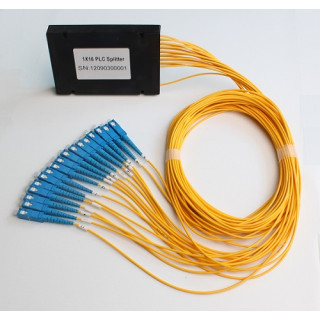
The ABS PLC splitter comes in a strong plastic case. It is shaped like a small box and is easy to install in fiber distribution boxes, especially in outdoor or wall-mounted environments. The ABS PLC splitter case protects the internal parts from dust, moisture, and physical damage. This type of splitter is commonly used in FTTH projects because it’s simple, durable, and cost-effective. You can find ABS splitters in different configurations, such as 1×4, 1×8, 1×16, and 1×32, depending on how many users or devices you want to connect.
2. Rack Mount PLC Splitter
The rack mount PLC splitter is made to fit inside a standard 19-inch telecom or data rack. It is often used in central offices, headends, and data centers. This type of splitter is great for places where many fibers need to be organized neatly in one place. It usually has multiple fiber outputs and is protected inside a metal housing that slides into a rack. It’s a clean and professional way to manage high-density fiber connections.

rack mount plc splitter
3. Mini Plug-in and LGX Module Splitters
There are also smaller versions, like mini plug-in PLC splitters and LGX module splitters. These are compact and easy to insert into fiber panels or boxes. They are good for installations where space is limited or where quick plug-and-play connections are needed.
Where Are PLC Splitters Used?
PLC splitters are used in many parts of fiber optic networks. One of the most common uses is in FTTH networks, where one fiber signal is split and sent to many houses or buildings. This helps telecom companies deliver internet and TV services without laying a fiber line to each home.
They are also used in PON (Passive Optical Networks), which support multiple users through one line. In CATV (Cable Television) systems, splitters are used to deliver TV signals to different homes or apartments. Inside data centers, splitters help manage signals between servers, switches, and storage systems. Lastly, they are used in testing setups to share signals from one light source to different testing points.
Tips for Using PLC Splitters
Choose the right split ratio. For small networks, you might only need a 1×4 or 1×8 splitter. For bigger networks, you may need a 1×32 or even 1×64 splitter.
Label everything clearly. In systems with many cables, good labeling helps prevent mistakes and saves time.
Think about the future. If your network may grow, use rack mount splitters to leave room for expansion.
Check the environment. For outdoor use, pick ABS PLC splitters that can handle weather changes. For indoor use, rack mount options are best.
Watch the signal loss. Every time you split a signal, there is some signal loss. Make sure your system can handle it.
Frequently Asked Questions (FAQ)
- What is the difference between PLC and FBT splitters?
PLC splitters use chip-based technology to evenly split the light signal. They are better for larger networks and higher split counts (like 1×32 or 1×64). FBT splitters are made by fusing fibers together and are cheaper, but they are less stable and work best for smaller splits like 1×2 or 1×4.
- What split ratios are available for PLC splitters?
PLC splitters come in many split ratios such as:
1×2, 1×4, 1×8, 1×16, 1×32, 1×64
2×4, 2×8, 2×16, 2×32 (dual input)
The number after “1x” or “2x” shows how many outputs the splitter has. Higher numbers mean the signal is shared with more users, but the signal strength is lower per output.
- Do PLC splitters reduce signal strength?
Yes, splitting a signal will reduce its strength. This is called insertion loss. For example:
1×2 splitter: about 3.5 dB loss
1×8 splitter: about 10.5 dB loss
1×32 splitter: up to 17 dB loss
Good-quality splitters are designed to reduce loss as much as possible and keep it even across all outputs.
- Can PLC splitters be used indoors and outdoors?
Yes. ABS PLC splitters are good for outdoor use because of their strong plastic housing. Rack mount PLC splitters are made for indoor setups like data centers. Just choose the right one based on where you plan to install it.
- How do I choose the right PLC splitter?
Think about how many users or devices you need to connect, where you will install the splitter, and if your network may grow later. Also, check if your system can handle the signal loss from splitting. This will help you choose the right type and size.
Conclusion
A PLC splitter is a small but powerful part of any fiber optic network. It allows one signal to be shared with many users, saving time, space, and money. Whether you use an ABS PLC splitter for outdoor FTTH networks or a rack mount PLC splitter in a data center, it helps make your network more efficient and reliable.
Now that you understand what a PLC splitter is, what it does, and how to use it, you’ll be better prepared to choose the right one for your project. If you’re planning a fiber optic network and need help selecting the right splitter, feel free to contact our team. We’re happy to help you find the best solution for your needs.


