
In today’s fast-paced world, businesses and organizations are constantly looking for ways to improve the performance and efficiency of their network infrastructure. One of the key components enabling this progress is the fiber media converter. These devices play an essential role in bridging the gap between different types of network media, allowing organizations to leverage the benefits of both fiber optic and copper-based networks. But why exactly do we need fiber media converters, and how do they contribute to better connectivity? Let’s dive into the reasons!
What Exactly Are Fiber Media Converters?
At their simplest, fiber media converters are compact devices that translate signals between copper-based Ethernet (using traditional twisted-pair cables) and fiber optic cabling. They act as linguistic interpreters for your network, allowing different “languages” of data transmission to communicate seamlessly.

Reasons We Need Fiber Media Converters
1. Extending Network Reach Beyond Copper Limits
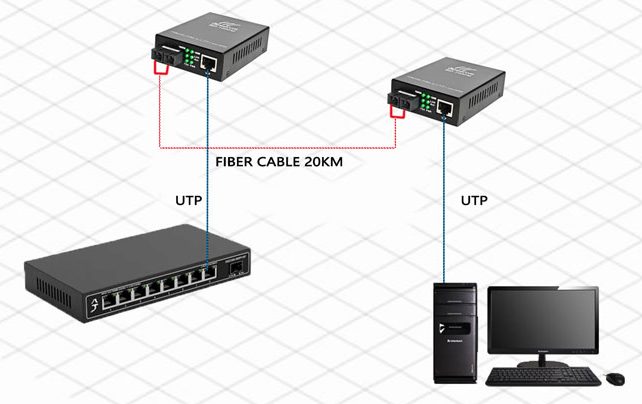
Traditional copper Ethernet cables face a strict distance limitation—typically 100 meters (328 feet) for optimal performance. Beyond this, signal degradation becomes significant. Fiber optics, however, can transmit data over kilometers without loss. Media converters allow organizations to extend their network reach dramatically without sacrificing performance, perfect for connecting buildings across campuses, industrial sites, or remote facilities.
2. Protecting Your Investment in Existing Infrastructure
For most businesses, a complete overhaul of their network infrastructure is neither feasible nor cost-effective. While fiber optic technology is the future, many companies still rely on existing copper-based equipment, such as switches, routers, and endpoints (e.g., computers and printers), for day-to-day operations.
Replacing all of this copper equipment with fiber optics would be a significant expense, and such a transition would take time and resources that most organizations simply cannot spare. Here’s where fiber media converters come in. These devices enable businesses to gradually transition to fiber optics while still using their existing copper-based devices. For instance, you can upgrade the core network backbone to fiber for higher performance and greater bandwidth, but keep your copper Ethernet connections at the endpoints like workstations, printers, and other devices. This approach helps companies future-proof their networks and maximize the value of their current infrastructure without committing to a full-scale upgrade all at once.
3. Future-Proofing Without Complete Overhaul
As data demands grow, fiber optics provide a virtually unlimited bandwidth capacity, making them the clear choice for future-ready networks. However, many end-user devices—computers, printers, and IoT sensors—still rely on copper connections. Media converters enable a practical, forward-looking strategy: organizations can implement a high-capacity fiber backbone today while still supporting current copper-based endpoints. This creates a scalable foundation that accommodates future bandwidth needs without requiring an immediate, organization-wide overhaul.
4. Overcoming Environmental Challenges
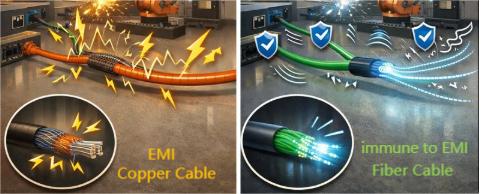
Copper cables are vulnerable to electromagnetic interference (EMI), which can cause signal loss, degradation, or data corruption. This is particularly problematic in environments with electrical machinery, fluorescent lighting, or heavy equipment—like manufacturing plants, hospitals, or data centers.
Fiber optics, however, are made from glass or plastic, and as such, they are immune to EMI. This makes fiber an ideal choice for these noisy environments. Fiber media converters allow organizations to take advantage of fiber’s immunity to interference while still using copper-based devices at the network endpoints.
5. Enhancing Security in Sensitive Applications
Fiber optics offer inherent security advantages—they do not emit electromagnetic signals, making it much harder for someone to intercept data being transmitted over fiber. Copper cables, in contrast, can emit signals that can be captured and analyzed by hackers with the right tools.
Additionally, it’s much easier to detect a fiber tap (an illegal access point in a network) than it is to detect a copper-based tap. For businesses handling sensitive data—such as in banking, healthcare, or government sectors—using fiber optics for data transmission enhances security. Media converters enable the adoption of fiber optics for these applications without needing to replace all the copper devices.
6. Simplifying Network Management and Segmentation
In large, complex networks, dividing the network into logical segments can help with traffic management, security, and performance optimization. For example, businesses may want to separate guest Wi-Fi traffic from internal office data or isolate different departments for security reasons.
Media converters are valuable tools in this context because they allow network administrators to create logical divisions in the network while maintaining the physical connections between fiber and copper devices. For instance, a media converter can connect different departments across fiber while allowing for the logical separation of their data flows. This segmentation helps manage network traffic more efficiently, enhances security by isolating sensitive data, and ensures optimal performance by reducing congestion in heavily used segments.
Understanding Why we need to know
Understanding why we need technologies like fiber media converters isn’t just for network engineers. It’s crucial for several practical, decision-making, and even strategic reasons:
1. For Financial & Operational Decision-Makers:
To Make Informed Budgeting and Investment Decisions
When planning a network upgrade or a new office setup, you’ll face a classic dilemma: “Do we rip-and-replace everything, or can we evolve gradually?”
Without this understanding: You might approve a vastly more expensive proposal to replace all switches and endpoints at once, not knowing a hybrid solution exists.
With this understanding: You can champion a phased, cost-effective approach. You’ll know that using media converters to create a fiber “backbone” between buildings while keeping existing copper gear in offices is a smart way to control costs and extend the life of your current investment.
To Evaluate Vendor Proposals
Vendors might push solutions that favor their product line or maximize their profit.
Without this understanding: You’re at the mercy of their expertise and must take their recommendations at face value.
With this understanding: You can critically assess proposals. You can ask: “Are you proposing fiber to every desk because it’s necessary, or because it’s more lucrative? Could we use media converters at key aggregation points instead?” You become a savvy buyer, not just a budget signatory.
2. For Problem-Solvers & Project Managers:
To Solve Real-World Problems
When network problems arise—like slow internet, dropped video calls, or connectivity issues—it’s easy to blame software or the service provider. But often, the issue lies with the physical network infrastructure.
For example, EMI could be interfering with data transmission, or the network distance might exceed the capabilities of copper cables. By understanding the role of fiber media converters, you can quickly identify and address these issues. You’ll know when to switch to fiber to avoid these problems, whether it’s for a noisy factory floor or a long-distance connection.
3. To Bridge the Communication Gap Between Departments
A company’s success often hinges on how well technical teams (IT, Engineering) and business decision-makers (Finance, Operations, Leadership) communicate.
Without this understanding: IT says, “We need $50k for a fiber upgrade due to EMI and distance issues.” Finance hears: “IT wants shiny new cables for no clear reason.”
With this understanding: You can translate. You can explain: “The new machinery in the plant is causing electrical ‘noise’ that corrupts data on our current cables, leading to production errors. A fiber link, which is immune to that noise, will solve this. We can use converters to connect to our existing control systems, keeping that cost down.” This frames the expense as a solution to a business problem (production errors), not a technical whim.
Conclusion
In summary, understanding fiber media converters is not just about knowing how they work—it’s about empowering yourself to make better decisions for your network infrastructure. It allows businesses to stay competitive, reduce costs, optimize performance, and build networks that can handle future demands. This knowledge is critical for anyone involved in managing or building networks, from small businesses to large enterprises.
Keep Learning
The Ultimate Guide to Fiber Media Converters:Types, Uses, and How to Choose?


