
1550 nm Transmitter – External Modulated DFB Laser


Short Description:
1550 nm Transmitter designed for CATV signals, HFC networks, cable phone, and cable data transmission, the 1550 nm transmitter combines a 1550nm DFB laser with external modulation technology to deliver stable optical performance for long-distance optical transmission systems. The external modulation design provides customers with low-chirp, high-linearity op…Description
Specification
Application
Order information
Q&A
Product Tags
Reviews
Description
1550 nm Transmitter designed for CATV signals, HFC networks, cable phone, and cable data transmission, the 1550 nm transmitter combines a 1550nm DFB laser with external modulation technology to deliver stable optical performance for long-distance optical transmission systems. The external modulation design provides customers with low-chirp, high-linearity optical signals that are essential for long-haul CATV and data transmission. Unlike direct modulation, this external transmitter maintains the 1550 nm Transmitter DFB laser in continuous wave operation, allowing the optical modulator to precisely control the light intensity without introducing unwanted frequency variations. This results in reduced CSO distortion, improved CNR performance, and the ability to support high-power distribution networks with extended reach.
The external transmitter integrates seven functional modules, including the RF control module, DFB laser module, optical modulator module, SBS control module, CSO control module, communication and display control module, and power supply module. This integrated architecture enables coordinated operation of the system while providing monitoring and control functions for reliable network performance. Featuring adjustable SBS threshold control up to +19dBm, intelligent AGC/MGC control, automatic CSO optimization, and comprehensive optical power monitoring, it is engineered to support high-performance optical distribution networks while providing convenient management through both console and WEB interfaces.
1550 nm Transmitter Working principle
Automatic gain control circuit (AGC) or manual gain control circuit (MGC) amplifies the RF signal. AGC or MGC control makes the optical modulator maintain a suitable input level. Use the detected RF root-meansquare(RMS)-total power to calculate the optical modulation index(OMI).
In general we recommend using the AGC function, and special users can use the MGC function to adjust the CNR/CSO/CTB performance indexes.
The core of transmitter is the optical modulator. The 1550nm signal input the optical modulator, make the laser intensity changed follow the external RF signal voltage, and then generate the AM optical signal.
Stimulated Brillouin Scattering (SBS) occurs, when the optical input power is greater than a certain threshold value. SBS generate the lower frequency backscattered light which will attenuate the transmission light and return to the laser while destroying its performance. Causing optical power fluctuation, generates large noise, and seriously deteriorates the system carrier to noise ratio (CNR). To improve the SBS threshold, this optical transmitter adopts SBS control technology which is independent researched and developed by ourselves. The threshold value can be set up to 19dBm.
The optical modulator has a two-way optical signal output. Parts of that signal are routed to an InGaAs photodiode. This detection of the optical signal has two functions:
1) Detect whether the laser is normal working. Once the output optical power is 2dB lower than standard power, alarm will be set off.
2) Detect CSO distortion to optimize the bias point of the optical modulator. For working normal the detector circuit needs at least two carrier signal inputs with an interval of 24MHz. There is a CSO initialization program in the boot process. If the CSO install failed, the RF indicator will flash red, see details in 6.2 Troubleshooting.
Block Diagram
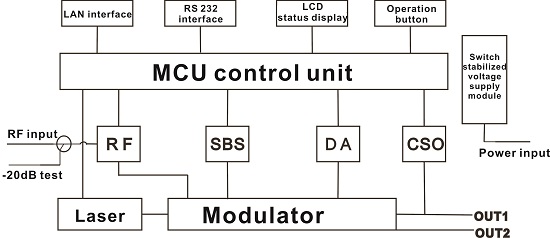
Technique Parameters
Optical Parameters
| Item | Unit | Value |
| Optical Wavelength | nm | 1545~1560 (or specified by the user) |
| Side-mode Suppression ratio | dB | >30 |
| Relative Intensity Noise | dB/Hz | <-160 |
| Wavelength Adjustment Range | GHz | +/-50GHz |
| Optical Power | dBm | 2*5, 2*7, 2*8, 2*9, 2*10 |
| SBS Threshold Value | dBm | +13~+19 (Continuously adjustable) |
| Laser Linewidth | MHz | 0.3 |
Technical Specification
| Item | Unit | Technical Parameters |
| RF range | MHz | 47~1003 |
| RF flatness | dB | +/-0.75 |
| RF return loss | dB | >16 |
| RF input impedance | Ω | 75 |
| RF input connector type | F type | |
| Rated input level | dBμV | 80 |
| Input level range | dBμV | 78~96 (AGC mode, modulating signal) |
| AGC control range | dB | +3~-3 |
| MGC adjustable range | dB | 0~15 |
| Optical connector | SC/APC, FC/APC | |
| Operating temperature | °C | -5~45 |
| Storage temperature | °C | -30~+70 |
| Power Source Specification | V | 90~265VAC |
| 36~72VDC | ||
| Consumption | W | ≤60 |
| Dimension | mm | 483(L) × 455(W) × 44(H) |
| Total Weight | kg | 5.5 |
Panel Interface and Menu System Description
1550 nm Transmitter Front Panel

| 1 | Power indicator | 2 | AGC indicator | 3 | RF modulation degree indicator |
| 4 | Laser indicator | 5 | LCD | 6 | ESC key |
| 7 | UP key | 8 | DOWN key | 9 | Enter key |
| 10 | RF input port (or on the rear panel, optional) | 11 | -20dB RF input test port |
1550 nm Transmitter Rear Panel

| 1 | Ground stud | 2 | Power module | 3 | Fan |
| 4 | RF input port (or on the front panel, optional) | 5 | RS232 interface | 6 | LAN interface |
| 7 | Optical output interface A (or on the front panel, optional) | 8 | Optical output interface B (or on the front panel, optional) |
Power Module
220V Power Module
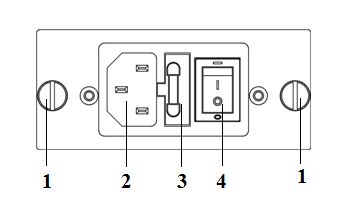
| 1 | Mounting screws | 2 | 220V power outlet | 3 | Fuse |
| 4 | Power switch |
48V Power Module
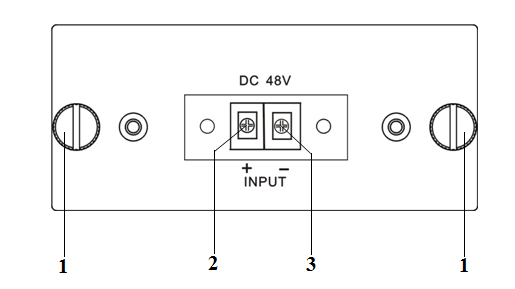
| 1 | Mounting screws | 2 | + Positive terminal block | 3 | – Negative terminal block |
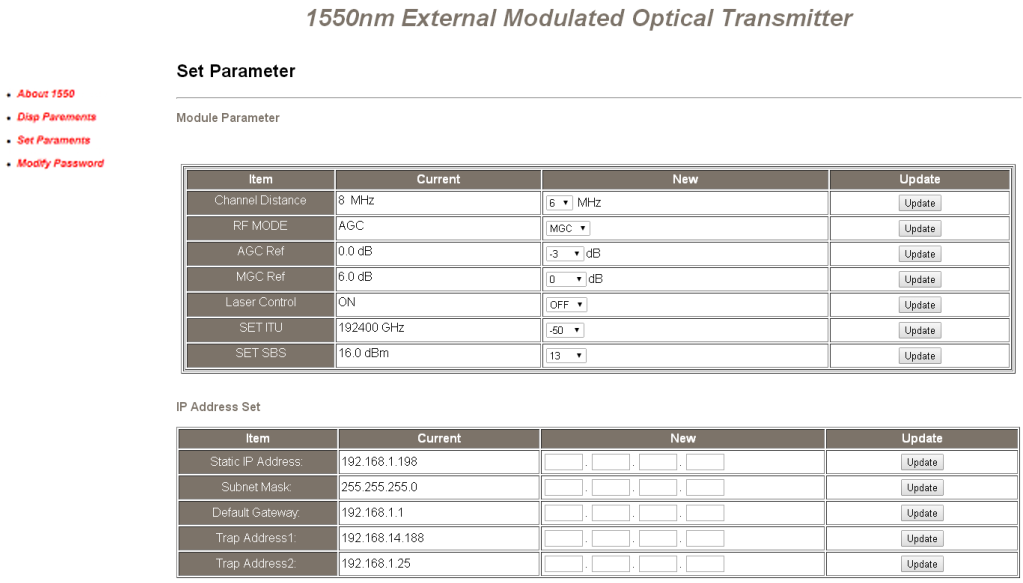
1550 nm Transmitter WEB Network Management
Open the IE browser, type the IP address and enter the interface as follows:
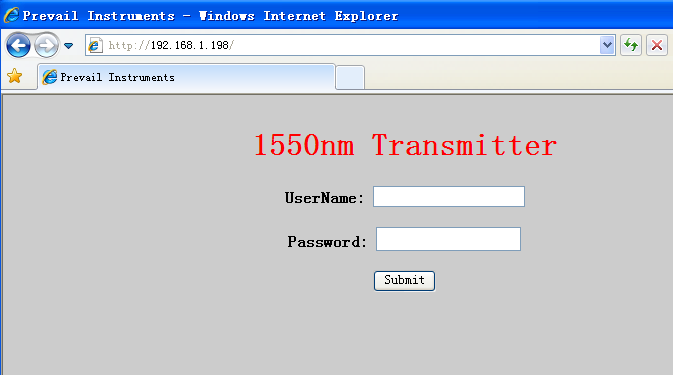
Specification
Application
- High-performance long-distance transmission
- High-power distribution network
- Redundancy loop architecture
- FTTx network
- RFOG application
- DWDM network
Order information
Q&A
Q: Can the external-modulated transmitter reach 50KM?
A: Yes.
Product Tags
Reviews
0 reviews
5


