
When upgrading to 10G networking, one of the most practical decisions isn’t just whether to deploy 10G—but how. Network engineers typically choose between three common interconnect options, all of which use the SFP+ form factor:
- 10GBase-T SFP+ (Copper SFP modules)–Uses standard RJ45 Ethernet cabling
- SFP+ DAC cables(Direct Attach Copper cables)–Pre-terminated twinax cable with integrated SFP+ connectors
- Fiber SFP+ (Optical modules)–Uses fiber optic cabling with LC or other optical connectors
Each has its own trade-offs in cost, flexibility, power consumption, and deployment scenario. This guide explains when it makes sense to choose copper SFP modules over DAC or fiber SFP+, with deeper technical reasoning and real deployment logic.
By the end of this post, you will have a clear decision framework for your next 10G deployment—and you will understand why copper SFP modules are often the overlooked sweet spot in short-to-medium range connections.
Table of Contents
- What Is a Copper SFP?
- The 3 Ways Simple Comparison
- When to Choose 10GBase-T SFP+
- Situations Where You Should NOT Use Copper SFP
- Practical Deployment Examples
What Is a Copper SFP?
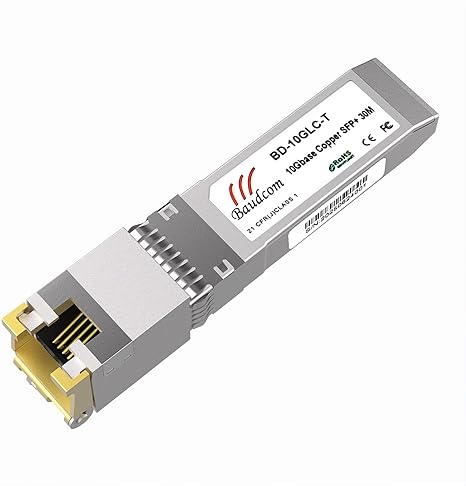
A copper SFP module (formally called a 10GBase-T SFP+ module) is a transceiver that enables SFP+ ports to transmit data over standard RJ45 Ethernet cables. Instead of converting signals into light (like fiber SFP+ modules), it uses electrical signaling defined by the 10GBase-T standard.
Inside each copper SFP module, there is a sophisticated DSP (digital signal processor) that equalizes the signal over long copper runs. This is what allows 10G speeds to travel up to 80–100 meters over ordinary Cat6a or Cat7 cabling. The DSP is also why copper SFP modules consume more power than their DAC or fiber counterparts—but that trade-off is often worth it for the flexibility they provide.

In practical terms, a copper SFP module allows network engineers to integrate traditional Ethernet cabling into high-speed 10G environments without redesigning the physical layer. If your building already has Cat6a running through the walls, you can simply plug a copper SFP module into your switch and connect to the existing jack. No new cabling, no specialized tools, no fiber cleaning supplies—just 10G speed over the copper you already own.
The 3 Ways Simple Comparison
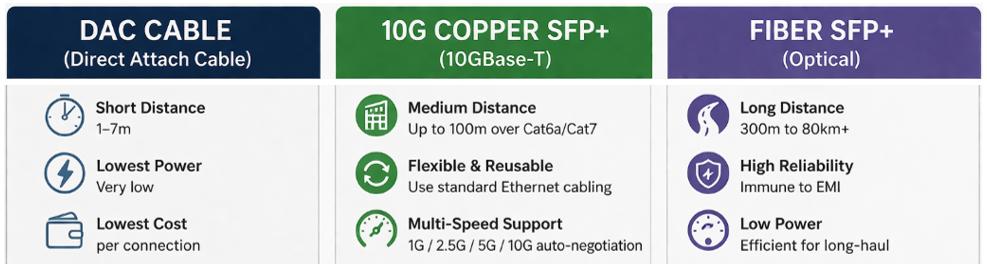
DAC (Twinax cable) – Lowest cost, lowest latency, but limited to 7‑10 meters and fixed lengths. Once you order a DAC at a specific length (e.g., 3 meters), you cannot use it for a 5‑meter run without leaving slack or replacing the entire assembly.
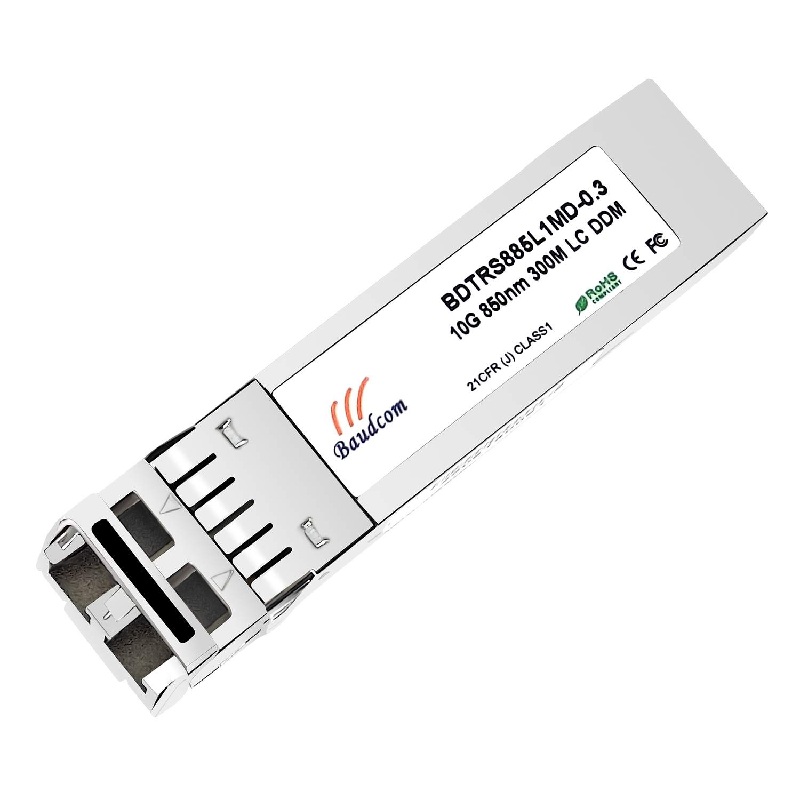
Fiber SFP (SR/LR SFP+) – Long distances (300m‑20km+), best for EMI‑prone or inter‑building links, but higher cost per port and requires separate cable management. Fiber also demands attention to polarity (Tx vs. Rx), connector types (LC, SC), and cleaning supplies that most copper‑focused teams do not keep in stock.
10G copper SFP – Up to 30‑80m (Cat6a/Cat7), uses existing structured cabling, flexible length changes, but slightly higher power and latency than DAC. The power trade‑off is due to the complex DSP (digital signal processor) inside each module that equalizes the signal over long copper runs.

10G Connectivity Options: Quick Comparison
| Feature | 10GBase-T SFP+ (Copper) | DAC Cable | Fiber Optics |
| Medium | Copper (RJ45) | Twinax cable | Optical fiber |
| Distance | Up to 100m | 1–7m typical | 300m–80km+ |
| Power Consumption | High | Very low | Low |
| Latency | Higher | Lowest | Low |
| Flexibility | High | Low | Medium |
| Cost (Short Distance) | Medium | Lowest | Higher |
When to Choose 10GBase-T SFP+
1. You Want to Reuse Existing Copper Cabling
If your building is already wired with Cat6 or Cat6a Ethernet, choosing a copper SFP module eliminates the need for costly recabling. Fiber deployment often involves not just cable replacement, but also new patch panels, fiber trays, and specialized installation tools.
In many enterprise environments, structured cabling is already one of the biggest sunk costs. By using a 10G copper SFP, you extend the lifecycle of that investment while still achieving 10G speeds.
Additionally, copper cabling is easier to manage and repair. IT teams are typically more familiar with RJ45 termination and testing, which reduces operational complexity during upgrades.
👉 This is a key reason why understanding what is a copper sfp matters—it’s fundamentally about compatibility with existing infrastructure.
2. You Need Flexible Patch Lengths (Beyond DAC Limits)
DAC cables are pre-terminated and come in fixed lengths (e.g., 1m, 3m, 5m). This rigid structure works well inside racks but becomes limiting when devices are spread across rooms or floors.

A 10G copper SFP module, on the other hand, allows you to use custom-length Ethernet cables, which can be routed through walls, ceilings, and patch panels. This makes it much more adaptable in real-world installations where distances are not fixed or predictable.
For example, in an office environment:
Workstations may be 20–50 meters away from aggregation switches
Network paths often go through multiple patch points
With copper SFP, you can design around the building layout instead of being constrained by cable length options.
3. Your Network Requires Multi-Speed Compatibility
One major advantage of a 10G copper SFP module is auto-negotiation across multiple speeds. This is especially valuable in networks that are transitioning gradually from 1G to 10G.
Instead of forcing all connected devices to operate at 10G, the module can dynamically adjust to the highest supported speed of the connected device. This ensures stable connectivity even when mixing legacy and modern hardware.
For example:
A 10G switch port can connect to a 2.5G access point
A 10G aggregation switch can connect to older 1G endpoints
This flexibility reduces the need for immediate, large-scale hardware replacement and supports phased upgrades—something DAC and many fiber modules cannot do as effectively.
4. You Prioritize Ease of Deployment Over Power Efficiency
Deploying a copper SFP module is straightforward and requires minimal specialized knowledge. Unlike fiber, there’s no need to worry about connector cleanliness, polarity, or optical signal loss due to bending or contamination.
This makes copper SFP particularly attractive in environments where:
Installation teams are not fiber-trained
Rapid deployment is required
Maintenance simplicity is a priority
However, this convenience comes with trade-offs. Copper SFP modules consume significantly more power (often 2–3W per port) and generate more heat compared to DAC or fiber.
In small to medium deployments, this may not be a major issue. But in high-density switches, cumulative heat and power usage can impact cooling design and operational costs.
5. You’re Working in Office or Enterprise Access Networks
In enterprise LAN and campus environments, the network topology often includes long horizontal cabling runs, patch panels, and multiple intermediate connection points. This is where 10GBase-T SFP+ modules perform best.
They integrate seamlessly into:
Office floors with structured cabling systems
Campus networks connecting multiple buildings internally
Access-layer switches connecting to end devices
Unlike DAC (limited to rack-level use) or fiber (more common in backbone/aggregation layers), copper SFP modules bridge the gap between performance and practicality in access networks.
They are especially useful in scenarios where network upgrades must be implemented without disrupting daily operations.
Situations Where You Should NOT Use Copper SFP
❌ High-Density Data Centers
In data centers with hundreds of ports, the higher power consumption of copper SFP modules becomes a serious concern. Increased heat output requires more cooling, which raises operational expenses and reduces overall efficiency.
❌ Ultra-Low Latency Requirements
Applications such as high-frequency trading or real-time processing demand minimal latency. DAC cables provide near-zero latency, while 10GBase-T introduces additional encoding and processing delays.
❌ Long-Distance Links (>100m)
Copper Ethernet has a physical limitation of 100 meters. For longer distances, fiber optics are not just better—they are necessary.
Practical Deployment Examples
Practical Deployment Examples
Scenario 1: Office Upgrade
Existing Cat6 cabling already deployed
Need to upgrade from 1G to 10G
✅ Best choice: 10G copper SFP module
Because it avoids rewiring and supports gradual upgrades with minimal disruption.
Scenario 2: Server Rack Interconnect
Devices within the same rack or adjacent racks
Distance less than 3 meters
✅ Best choice: DAC
Because it offers the lowest cost, lowest latency, and lowest power consumption.
Scenario 3: Building-to-Building Link
Distance exceeds 300 meters
Requires high reliability and EMI immunity
✅ Best choice: Fiber optics
Because copper cannot support long distances or harsh environments effectively.
Conclusion
Choosing between DAC, fiber, and a copper SFP module comes down to distance, flexibility, and existing infrastructure. When you understand what is a copper SFP, you recognize it is not a compromise—it is a tool for the 5‑to‑50‑meter zone where DAC cables are too stiff and fiber optics are too elaborate. It fills the gap that both competing technologies leave open, offering the plug‑and‑play simplicity of copper with the speed of modern 10G networking.


