
In the world of modern networking, communication between different systems often requires various types of media converters. it’s easy to forget that countless industrial systems, security networks, and utility infrastructures still rely on a technology that’s been around for decades: serial communication (RS-232, RS-422, RS-485). But what happens when you need to connect these legacy serial devices across a factory floor, between buildings, or even across a city? Enter the unsung hero of network integration: the Serial to Fiber Media Converter.
These devices are essential for converting serial signals into fiber optic signals, enabling long-distance, high-speed data transmission with minimal signal loss. Let’s dive deeper into the functions, principles, types, and applications of serial to fiber media converters.
Functions of a Serial to Fiber Media Converter
At its core, a Serial to Fiber Media Converter is exactly what its name suggests: a compact device that converts electrical serial data signals into optical signals for transmission over fiber optic cables, and vice versa.
This conversion offers several significant advantages:
Long-Distance Transmission:
While serial communication (RS-232, RS-485) is typically limited in distance (usually up to 15 meters for RS-232 and 1200 meters for RS-485), fiber optics can span distances of up to tens of kilometers without signal degradation.
Signal Conversion:
The converter takes serial data from devices like industrial machines, cameras, or servers and transforms it into light signals suitable for fiber optic cables.
Improved Performance:
Fiber optic cables are less susceptible to electrical interference, which ensures better performance in environments with high electromagnetic interference (EMI).
Cost-Effective:
Instead of deploying costly copper cabling for long-distance communication, fiber optic solutions offer a more economical and scalable way to cover large areas, making the installation of communication networks much more feasible in diverse environments.
Principles of a Serial to Fiber Media Converter
Receive: The converter accepts the electrical serial data (from a PLC, industrial sensor, CCTV PTZ controller, or access control system, for example).
Convert: Its internal circuitry converts this data into a format suitable for light transmission. This involves translating voltage levels into corresponding light pulses (LED or laser).
Transmit: It sends these light pulses down the fiber optic strand.
Reverse at Destination: Another converter at the far end receives the light pulses, converts them back into electrical serial signals, and delivers them to the target device.
This simple process solves one of the biggest limitations of traditional copper serial cables: distance. RS-232 is limited to about 15 meters, while RS-422/485 can reach up to 1200 meters. Fiber optics, using a converter, can stretch this to tens of kilometers without any signal degradation.

Types of Serial to Fiber Media Converters
Serial to Fiber converters come in various flavors to match your specific need:
By Serial Protocol:
RS-232 to Fiber: Often used for connecting point-to-point devices like consoles, modems, or weigh scales.
RS-422/485 to Fiber:
The most common type for industrial applications, supporting multi-drop networks for connecting multiple devices (like sensors on a production line) over a single fiber pair.
See What is the difference between RS232 RS422 and RS485?
By Fiber Type:
Single-mode (SM): Uses a thin core and laser light for long-distance transmission (up to 80km or more).
Multi-mode (MM): Uses a wider core and LED light for shorter distances (typically up to 5km).
By Form Factor:
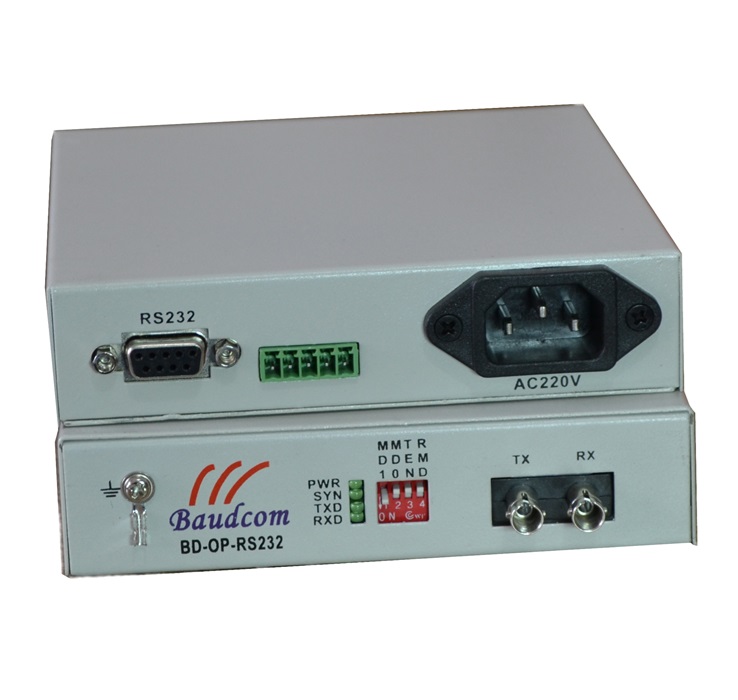
Stand-alone (Desktop): Compact units for individual point-to-point links.
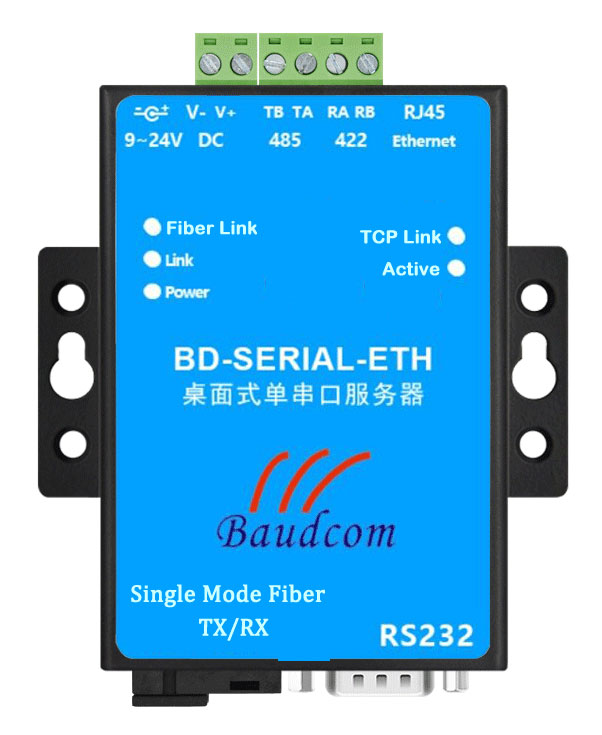
DIN-Rail Mountable: Designed for direct installation in industrial control cabinets.
Applications
The application of serial to fiber media converters spans various industries and use cases. Some of the most common applications include:
Industrial Automation:
In factories and plants, many machines and controllers rely on serial communication (RS-485) for networking. Serial to fiber converters allow these devices to communicate over long distances using fiber optic cables, making it possible to integrate equipment from different parts of a factory or across multiple buildings. Connecting PLCs, HMIs, motor drives, and instrumentation across a sprawling manufacturing plant.

Security Systems:
Security systems often use serial communication to transmit data from cameras, alarms, and control panels. By using a serial to fiber converter, security networks can be expanded across large campuses or cities, providing reliable communication over long distances with minimal signal loss.
Telecommunications:
Telecom companies use serial to fiber media converters to connect remote terminals, base stations, or switches. This technology enables high-quality, long-distance communication in the telecom infrastructure.
Remote Sensing and Data Acquisition:
In environmental monitoring or remote sensing systems, serial devices like sensors and monitoring equipment are often situated far from the main control room or data center. Fiber optic networks equipped with serial to fiber media converters allow these devices to send data over great distances without signal degradation.
Building Automation:
Smart buildings with interconnected HVAC systems, lighting, and other utilities use serial communication for control and monitoring. By using serial to fiber media converters, these systems can be connected over fiber networks, allowing them to communicate over larger buildings or even across entire campuses.
Conclusion
Serial to fiber media converters are an essential tool in bridging the gap between legacy serial devices and modern fiber optic communication systems. By converting serial data into fiber optic signals, they enable long-distance communication, reduced interference, and more reliable data transmission, making them an indispensable solution in industries like automation, telecommunications, security, and more.
When choosing a serial to fiber converter, it’s essential to consider the specific type of serial communication (RS-232, RS-485, RS-422) and the requirements of your network to ensure optimal performance and compatibility.
Keep Learning
The Ultimate Guide to Fiber Media Converters:Types, Uses, and How to Choose?


