
In the realm of Fiber-to-the-Home (FTTH) and other FTTx architectures, the Optical Network Unit (ONU) is a critical piece of customer-premises equipment (CPE). It acts as the essential bridge, converting the high-speed fiber optic signal coming into your home or business into a format that your everyday devices can understand.
Think of the ONU as the translator for the language of light (fiber) into the language of electricity (Ethernet/Wi-Fi). This comprehensive guide, drawing from Baudcom’s extensive technical expertise, will provide a deep dive into everything you need to know about ONUs.
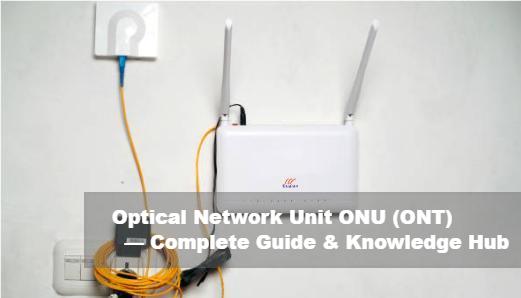
Table of Contents
- What is an ONU?
- How ONU Works
- Types of ONU
- Deployment Best Practices
- ONU Configuration & IP Management
- ONU Performance & Troubleshooting
- ONU as WiFi Router
- Latest Trends in ONU Technology
- FAQs
What is an ONU(Optical Network Unit)?
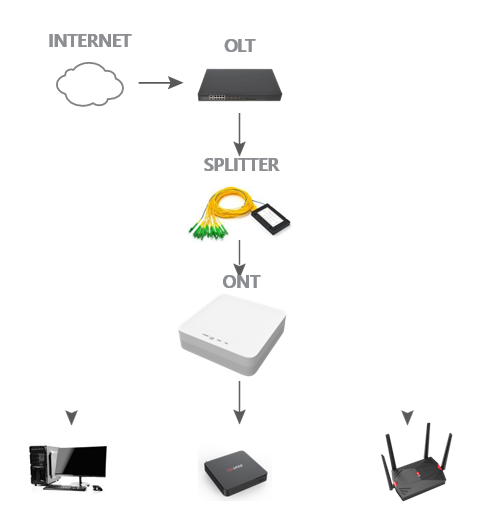
An ONU (Optical Network Unit) is a device located at the end-user’s premises in a passive optical network (PON). Its primary function is to terminate the fiber optic line, convert the optical signal transmitted from the OLT (Optical Line Terminal) at the service provider’s central office into electrical signals, and provide connectivity for end-user devices.
In simpler terms, it’s the box that the fiber cable from your Internet Service Provider (ISP) plugs into, giving you access to high-speed internet, voice (VoIP), and IPTV services.
How ONU Works
ONUs sit between the Optical Line Terminal (OLT) at the central office and the customer premises. They manage bandwidth allocation, ensure quality of service (QoS), and handle protocols for data, voice, and video services.
- ONU converts optical signals to electrical for user devices
- Performs upstream transmission and bandwidth management
- Enables triple-play services (data, voice, video)
For deeper insights, see: How ONU Function and Support Work Together to Optimize FTTH Performance
Types of ONU
| Type | Description | Blog Reference |
| EPON ONU | IEEE 802.3ah standard, supports triple-play | G/EPON ONU IP Address, Configuration & Default Login |
| GPON ONU | ITU-T G.984+, widely used in FTTH | The Role of GPON ONU (ONT) and GPON OLT |
| XPON ONU / Dual-Mode | Supports both EPON & GPON | What is XGSPON ONU?, XGSPON ONU vs GPON ONU,XGS-PON ONT and XGS-PON OLT Compatibility, The Complete Guide to GPON vs EPON vs XPON ONUs: Which ONU is Best? |
| POE ONU | Provides Power-over-Ethernet on LAN ports | What is POE ONU, The Difference between Reverse PoE ONU and PoE ONU,ONT POE for PON system Networks |
| WiFi ONU / HGU | Integrated WiFi router functionality | WiFi 6 ONU: Why WiFi 6 is Better? |
| 10G / XGS-PON ONU | High-speed PON technology for modern networks | Where 10G ONUs Fit In |
Deployment Best Practices
An ONU does not work in isolation; it is part of a larger PON system. The key relationship is between the OLT and the ONU.
The OLT (Optical Line Terminal): Resides in the ISP’s data center. It is the starting point for the PON, controlling the bidirectional flow of data. Learn more about this symbiotic relationship in our blog: Understanding OLT and ONU in PON Network
The ONU (Optical Network Unit): Resides at your location. It receives the optical signal from the OLT, converts it, and distributes it.
The Process:
Downstream (OLT to ONU): Data is broadcast from the OLT to all ONUs. Each ONU only accepts the data packets intended for it.
Upstream (ONU to OLT): ONUs transmit data back to the OLT on a different wavelength. The OLT assigns specific time slots to each ONU to avoid collisions.
For a detailed look at their roles in a specific technology, read: How GPON OLT and ONT Work Together in Modern Fiber Networks
To ensure optimal FTTH network deployment:
- Follow correct OLT and ONU installation procedures
- Maintain recommended optical signal budgets
- Use high-quality connectors and splitters
- Verify ONU registration and firmware compliance
A successful FTTH network starts with correct installation. Follow our detailed guide: OLT and ONU Installation Best Practices.

ONU Configuration & IP Management
Proper configuration ensures optimal network performance and simplifies management. Topics include:
- Assigning IP addresses and logging into ONU interfaces
- VLAN setup and bandwidth allocation
- Remote provisioning via OLT
- Firmware updates and automated configuration
After installation, proper configuration is vital for security, QoS, and network management. Master the process: The Essential Guide to ONU Configuration for Better Network Management
Need to access your device’s settings? Find the steps here: G/EPON ONU IP Address, Configuration & Default Login.

ONU Performance & Troubleshooting
Common challenges with ONU performance include:
- Signal attenuation and optical power loss
- Latency and bandwidth fluctuations
- Hardware or firmware failures
Troubleshooting practices involve monitoring optical power, checking port statuses, and performing remote diagnostics.
Understand the common hurdles that affect ONU performance and how to overcome them: The Challenges of Optical Network Units (ONU) Performance
When an ONU goes offline, a systematic approach is needed. Learn how to diagnose common failures: ONU Failure Analysis
ONU as WiFi Router
Some ONUs can function as WiFi routers, providing wireless connectivity directly to end users. Key factors affecting WiFi performance include:
- Router chipset and WiFi standard (WiFi5 vs WiFi6)
- Environmental interference and placement
- LAN port speed and configuration
Blogs for reference: How to Improve ONU WiFi Router Speed: Key Factors
ONU vs. ONT vs. Modem: What’s the Difference?
ONU (Optical Network Unit): The broader term for the device that converts the optical signal.
ONT (Optical Network Terminal): Essentially an ONU designed for a single subscriber. In practice, for FTTH, the terms are synonymous. All ONTs are ONUs, but not all ONUs are ONTs.
Modem: A general term. An ONU/ONT is, therefore, a fiber optic modem.
For More clear detail: Is an ONT a modem?
Router: A device that routes traffic between different networks. So, can an ONU work as a router? Yes! Modern HGUs (Home Gateway Units) combine the functions of an ONU and a router. We explore this in detail here: ONU and Router, Can ONU Work As a Router?
Latest Trends in ONU Technology
WiFi6 and beyond for better wireless performance
XGS-PON / 10G ONUs for ultra-high-speed broadband
Dual-mode ONUs for network migration flexibility
Integration of smart home and PoE capabilities
Read more:
WiFi 6 ONU: Why WiFi 6 is Better?
FAQs About ONUs
Q: Can I buy my own ONU instead of renting from my ISP?
A: In some cases, yes. However, you must ensure it is fully compatible with your ISP’s OLT. Read about compatibility concerns here: Can different brands of OLT /ONU be compatible?(e.g., Huawei, NOKIA)
Q: What is a dual-mode ONU?
A: It supports both EPON and GPON, automatically detecting the network type.
Q: What is a POE ONU?
A: An ONU that provides Power-over-Ethernet to connected devices such as IP cameras or APs.
Post time: 2025-10-13

