
Fiber optic networks are the backbone of today’s internet and global communications. They carry data as light pulses through very thin glass fibers. However, as these signals travel long distances, they gradually lose strength and quality. Problems like attenuation (signal loss), dispersion (spreading), and jitter (timing errors) make it harder for the receiver to read the data correctly.
To solve these issues, engineers use devices called optical repeaters. Among them, the most powerful and widely used is the 3R repeater. The name 3R comes from its three important functions: Regeneration, Reshaping, and Retiming. These three steps bring the signal back to life, making it strong, clean, and perfectly synchronized for the next stage of transmission.
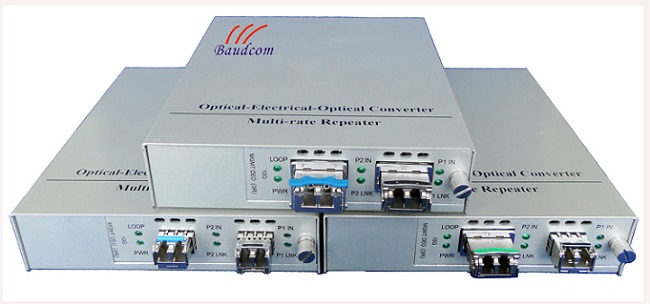
What is a 3R Repeater?

A 3R repeater is a type of optical repeater that completely restores optical signals for long-distance transmission. Sometimes it’s compared to a repeater amplifier, but it does much more than simply making a signal stronger.
An optical amplifier increases the power of a weak signal, but it also increases the noise and distortion.
A 3R repeater goes further by not only boosting the signal but also cleaning its shape and fixing its timing.
This process is called digital regeneration, which means the output signal is almost as good as the original signal sent at the beginning of the fiber. That’s why 3R repeaters are used in long-haul telecom, submarine cables, and high-speed networks (10G, 40G, 100G and beyond).
Think of it like this: if someone repeats your voice loudly (like an amplifier), they might repeat your words and the background noise. But if someone listens carefully, removes the noise, and repeats your words clearly and in rhythm, the message is much easier to understand. That’s the difference between an amplifier and a 3R repeater.
Why Optical Networks Need 3R Regeneration
A fiber optic cable is a thin glass strand that carries digital information as incredibly fast pulses of laser light. However, traveling thousands of kilometers is tough on these light pulses, and three main problems occur:
The Signal Gets Weaker (Attenuation): 📉 Just like your voice fades the farther you shout, light loses its energy as it travels through glass. This weakening is called attenuation. The signal becomes faint and hard to detect.
The Signal Gets Blurry (Dispersion): 🎨 As the light pulses travel, they physically spread out and start to overlap with their neighbors. It’s like a neat line of runners in a race slowly spreading out until everyone is bumping into each other. This blurring makes it hard to tell where one pulse ends and the next begins.
The Signal Gets Noisy (Amplifier Noise): 🔊 The first helpers we used, called optical amplifiers, give the light a boost. But they are imperfect. They boost the desired signal and any stray light particles (noise) in the cable. After several amplifications, this noise builds up, like the static you hear when turning up a radio with poor reception.
👉 A normal amplifier only fixes attenuation, but leaves dispersion and jitter untouched. A 3R repeater corrects all three problems by regenerating, reshaping, and retiming the signal.

How Does a 3R Repeater Work?

Here’s what each “R” in 3R does:
Regeneration (The “Fresh Start”): 🔄
This is the overall goal. The 3R repeater first converts the weak, noisy optical signal into a clean electrical signal. This is a crucial step because it allows the repeater to “read” the data and work with it intelligently. It then uses this information to command a laser to generate a completely new, pristine optical signal. The old, degraded signal is thrown away and replaced.
Reshaping (The “Art Restorer”): ✨
The incoming signal is often rounded and distorted. The repeater’s decision circuit acts like an art expert restoring a classic painting. It examines each smudged pulse and makes a clear judgment: “This was supposed to be a sharp ‘1’” or “This was meant to be a ‘0’.” It then commands the laser to output a new signal with perfectly square, clean pulses, exactly as they were originally sent.
Retiming (The ” Rhythm Coach”): ⏱️
Over long distances, the timing of the pulses can drift, causing them to arrive too early or too late—like a musician slowly falling out of rhythm with the band. The 3R repeater has a precise internal clock circuit that listens to the incoming signal’s timing and extracts its original beat. It then synchronizes the new, regenerated signal to this perfect rhythm, ensuring every single pulse is transmitted at exactly the right instant.
By performing all three of these tasks, the 3R repeater completely eliminates the accumulated noise and distortion. The output is a fresh, powerful, and perfect signal, as if it had just begun its journey.
Repeater vs Amplifier: What’s the Difference?
It’s easy to confuse a repeater amplifier (like EDFA) with a 3R repeater. Both extend signals, but they work differently:
| Feature | Optical Amplifier (EDFA) | 3R Repeater (Optical Repeater) |
| Function | Boosts signal power only | Regenerates, Reshapes, Retimes |
| Signal Type | Analog optical | Digital optical |
| Bit Error Rate (BER) | Not much improved | Strongly improved |
| Jitter Correction | No | Yes |
| Cost | Lower | Higher |
To view Repeater vs Amplifier, see When to Use an Optical Amplifier or Repeater
Advantages of 3R Repeaters 🌟
Reliable Long-Distance Reach – Signals can travel thousands of kilometers without quality loss.
Very Low Error Rate – Digital regeneration ensures error-free data transfer.
High-Speed Compatibility – Supports modern networks running at 10G, 40G, 100G, and beyond.
Critical Infrastructure Support – Keeps international networks, financial systems, and cloud data centers running smoothly.
Conclusion ✅
The 3R repeater is more than just an optical repeater. It provides Regeneration, Reshaping, and Retiming, giving the network a completely refreshed, clean, and synchronized signal.
When comparing repeater vs amplifier, the difference is clear: amplifiers only make signals stronger, but 3R repeaters regenerate the signal completely. This makes them essential for long-haul telecom, submarine cables, DWDM systems, and modern data centers.
Baudcom provides high-quality 3R repeaters, optical amplifiers, DWDM systems, and GPON/EPON solutions designed for reliable and scalable networks.
👉 Contact Baudcom today to learn more about our optical communication solutions and how they can strengthen your network performance.
Can Baudcom SFP+ to SFP+ media converter support repeater function?
Baudcom 1GE fiber mode converter, 10GE fiber converter and mini 10GE fiber mode converter , QSFP+ to QSFP+ Extender 40G Fiber Converter all can support this function.
【Edited in August 2025】


